Articles by "TechCrunch"

Showing posts with label TechCrunch. Show all posts

​​Here’s another edition of “Dear Sophie,” the advice column that answers immigration-related questions about working at technology companies.

“Your questions are vital to the spread of knowledge that allows people all over the world to rise above borders and pursue their dreams,” says Sophie Alcorn, a Silicon Valley immigration attorney. “Whether you’re in people ops, a founder or seeking a job in Silicon Valley, I would love to answer your questions in my next column.”

TechCrunch+ members receive access to weekly “Dear Sophie” columns; use promo code ALCORN to purchase a one- or two-year subscription for 50% off.


Dear Sophie,

We’re an early-stage startup that — like many other companies — is facing a significant challenge when it comes to recruiting talent. We have not posted job openings internationally, but we’ve received some applications from international talent.

This is all new territory for us. What’s your advice for hiring internationally? Also, I know the H-1B lottery is fast approaching.

Can you explain a bit more about this process?

— Eager Early-Stage Startup

Dear Eager,

Yes, the H-1B lottery is fast approaching! The period for registering H-1B candidates opens in March; there are a few steps companies need to take before then if they have never before participated in the H-1B lottery process. First, be sure to create an account with U.S. Citizenship and Immigration Services (USCIS), which conducts the lottery. Given this timeline, your company should determine as soon as possible whether the positions you are looking to fill and the prospective international talent you are looking to hire would qualify for an H-1B specialty occupation visa.

Check out my column in TechCrunch+ last week for more specifics on the lottery process. To bypass the H-1B lottery — or if a candidate is not selected in the lottery — your company could consider getting a cap-exempt H-1B for the candidate. Transferring an individual’s H-1B to your startup is also an option. To find out more about that process, take a look at this Dear Sophie column.

A futurist lens on international hires

I recently had a fascinating conversation with Jamais Cascio, a futurist and distinguished fellow at the Institute for the Future in Palo Alto. Cascio has some wonderful insight relevant to your question.

The population in the U.S. is getting older and the birth rate is declining; as such, we will increasingly need to look to immigration to keep our economy going. Cascio discusses three mindsets for dealing with radical changes in this chaotic world to remain strong as a company and succeed into the future. This advice is highly applicable to companies such as yours as you embark on an effort to hire from abroad.

The three mindsets that Cashio said would benefit companies are:

  • Resilience: Being able to withstand a shock to the system without breaking. For example, he said companies that have just-in-time delivery models are very brittle and prone to break down compared to those that have built-in slack into their system. Building in slack often requires additional resources and reduced efficiency and profit but offers built-in resilience.
  • Improvisation: Remain creative and nimble and be ready to embrace change.
  • Empathy: Probably the most critical of the three, this involves recognizing the humanity in others and what we do matters to others now and in the future. (I loved hearing that the role of the heart is and will be critical for business success!)

Embracing these mindsets while developing an immigration strategy that offers stability for international talent will be key to attracting and retaining talent and creating a company culture that fosters innovation and endurance. Listen to my podcast, “Tips for Companies to Support Valued Humans,” in which I discuss this in more detail.

A composite image of immigration law attorney Sophie Alcorn in front of a background with a TechCrunch logo.

Image Credits: Joanna Buniak / Sophie Alcorn (opens in a new window)

Specific visas to consider

Before we dive into visa specifics, please be aware that I recommend you consult an experienced immigration attorney, who can help you devise an immigration strategy for prospective international hires, as well as provide guidance on what visas would be appropriate given the job opening and prospective candidate. Take a look at a previous Dear Sophie column in which I offer an overview on immigration-related matters you should focus on if your startup does not yet have someone handling HR.

O-1A visa

If your prospective hires don’t make it through the H-1B lottery process I mentioned above, or you need to get them here more quickly than October and you can’t take the risk that they might not be selected in the H-1B lottery this year, a great option is the O-1A extraordinary ability visa. More and more of our startup clients are opting to pursue it for key executives and individual contributors with niche expertise. While the bar for qualifying for the O-1A is much higher than for the H-1B, the process for getting an O-1A is much quicker. And the O-1A does not have an annual cap or lottery process to contend with.

Visas for talent from specific countries

Specific visas exist for talent from Australia, Canada, Chile, Mexico and Singapore.

If the job candidate is an Australian national, an E-3 visa will allow that individual to work in the U.S. in a specialty occupation, just like an H-1B. E-3 visas also require the sponsoring employer to file a Labor Condition Application with the U.S. Department of Labor, as is required with H-1B petitions. A maximum of 10,500 E-3 visas is available each year.

Is the job candidate a Chilean or Singaporean national? If so, the candidate may qualify for an H-1B1 specialty occupation visa, which is an H-1B visa earmarked for citizens of Chile and Singapore. Thanks to special treaties the U.S. has with those two countries, professionals may qualify to receive H-1B1 visas on a fast-track basis. Each year, 1,400 H-1B1 visas are reserved for Chileans and 5,400 are reserved for Singaporeans — and rarely are those visas completely exhausted.

Professionals from Canada and Mexico can come to the U.S. to work under a TN visa, which was born out of trade treaties between Canada, Mexico and the U.S. TN visas are limited to professions listed in treaty agreements, but most of these jobs overlap with H-1B specialty occupations.

Some good news: Through the end of 2022, consular officers can now waive the in-person interview requirement for some individuals seeking some nonimmigrant (temporary) visas, including H-1Bs and O-1s. Individuals who are applying for a visa in their country or nationality of residence may have the interview waived if any of the following apply:

  • Previously issued any type of visa.
  • Never been refused a visa unless it was overcome or waived.
  • No ineligibility.
  • Citizens or nationals of a country that participates in the Visa Waiver Program.

Wishing you every success!

Sophie


Have a question for Sophie? Ask it here. We reserve the right to edit your submission for clarity and/or space.

The information provided in “Dear Sophie” is general information and not legal advice. For more information on the limitations of “Dear Sophie,” please view our full disclaimer. You can contact Sophie directly at Alcorn Immigration Law.

Sophie’s podcast, Immigration Law for Tech Startups, is available on all major platforms. If you’d like to be a guest, she’s accepting applications!


via Tingle Tech

To get a roundup of TechCrunch’s biggest and most important stories delivered to your inbox every day at 3 p.m. PST, subscribe here.

Hello and welcome to Daily Crunch for January 5, 2021! Today we have a great mix of news for you. Mega-rounds? Heck yes. Electric trucks from U.S. companies? Yep! Android cozying up to Windows? But of course. And some great essays on lock-up periods, LP transparency and more.

But before we do that, every once in a while I’m going to highlight a TechCruncher behind the scenes who deserves some love. Today it’s Henry Pickavet, one of our editors and guiding lights, someone I have known and worked with since my early 20s. He’s perfect, apart from the sports teams he follows and the fact that he likes cricket. Follow him on Twitter here if you are so inclined! —Alex

The TechCrunch Top 3

  • Making sense of OpenSea at $13B: From rumor to report to confirmation, the OpenSea funding round worth $300 million came to its conclusion quickly. Now the NFT marketplace is worth some $13 billion. So, TechCrunch did the obvious thing and asked if that number makes any darn sense. As it turns out, yes, but how much depends on your level of crypto-bullishness,
  • Android 🤝 Windows: While Apple has been busy defending its walls surrounding the garden that is iOS, Google and Microsoft have been busy paving roads between their Android and Windows operating systems. First, Microsoft announced that some Android apps would eventually run on Windows. And now, news that “Google is working with the likes of Intel, Acer and HP to [connect] your phone to your Windows PC.”
  • And here’s the *other* company now worth more than $10B: It’s Miro! Yep, the online workspace company, as we put it, is now worth some $17.5 billion after raising a $400 million round. The company claims it has 30 million users. Competitor Mural is also doing well, indicating that their market is fairly deep in the remote-work era.

Startups/VC

A few essays to start our startup download today, I think. The first comes from our own Connie Loizos diving into the “year of the disappearing lock-up.” In short, Loizos notes that the traditional forced holding period post-IPO is being dismantled in hot public offerings. Not that this is a guarantee of future results — the opposite, it seems — but it’s worth tracking the change to what was once a key IPO rule, and, frankly, mark of confidence.

Speaking of IPOs, the insurtech IPO wave of 2020 and 2021 is looking pretty darn threadbare today. TechCrunch took a look back at the struggles of names we’ve written about for ages, the Roots and Metromiles of the world, but also Oscar Health. It hasn’t done well either, it turns out.

Anna Heim wrote a fascinating piece on LP transparency. The idea that founders should care about where their investors get their money is not new. But what is fresh is the leverage that founders have over investors — the founder-investor power dynamic has flipped, leading more VCs to think that it might be time to open up their own books a little.

Now, more news!

  • Bankaya goes offline for customer acquisition: The hunt for new users is a global startup challenge, and one that leads to some interesting solutions. Mexican fintech Bankaya is taking an IRL tack to the challenge, noting that the major ad channels for its products are rife with competitors chasing the same eyeballs.
  • Tax advantaged crypto investments? Startup Alto just raised $40 million for what TechCrunch reports is a “self-directed IRA platform [that] provides a simpler, more affordable option for individuals to invest their retirement savings into alternatives,” at least in theory. I dig it.
  • Fractal goes unicorn with new $360M round: It turns out that this company is 21 years old, so it’s not a startup, per se. But it is a private company that just raised nine figures, so it hit our radar. The company’s analytics product does AI and analytics work for major companies.
  • SoftBank eyes new Indian investment: Pune-based ElasticRun is in talks to close a round worth $200 million or so from SoftBank Vision 2 and Goldman Sachs, Manish Singh reports for TechCrunch. The startup helps neighborhood stores “secure inventory from top brands and working capital,” we report.
  • Meet a very cute dishwasher named Bob: From the CES trenches, meet Bob. It’s a small dishwasher unit for apartment countertops that is efficient, and, dare we say it, adorable.
  • To close out our startup items, Xage has raised $30 million to help project critical infrastructure. Which is good, given that much of the power lines and water facilities that you depend on are fairly out of date and begging for nation-state shenanigans. (The startup’s name is pronounced zage, Ron Miller.)

4 trends that will define e-commerce in 2022

Multi Colored Note Paper on Cork Board

Image Credits: MirageC (opens in a new window) / Getty Images

Data privacy has been top of mind for online sellers and for good reason: Regulators are taking an interest, and iOS 14.5 lets users turn off data tracking, with negative consequences for “Facebook’s ad targeting.”

Bearing those factors and others in mind, Ben Parr, president and co-founder of e-commerce marketing platform Octane.ai, shared his predictions for 2022 with TechCrunch+:

  • Personalization and zero-party data become critical.
  • E-commerce embraces web3 and NFTs, but what will that look like?
  • Live shopping goes mainstream.
  • Slow but gradual improvement to the supply chain.

(TechCrunch+ is our membership program, which helps founders and startup teams get ahead. You can sign up here.)

Big Tech Inc.

We have a number of automotive-themed news items below, but let’s start on your phone with Instagram. The social subsidiary of the larger Meta empire is bringing back its chronological feed. Praise be. Forcing users to endure algorithmic timelines is lame, in my view, and something that moves power away from users toward the adtech gods that run social platforms. I might even re-sign up for Instagram now that this is fixed.

  • Mortgage data analytics company settles with FTC over data breach: Back in 2019, TechCrunch reported that “OpticsML, a New York-based vendor working for Ascension, left a database of highly sensitive financial data exposed to the internet without a password.” Now two years after that reporting, results!
  • GM promises a plethora of electric vehicles: If you want an electric Equinox or Blazer, GM is going to hook you up in 2023. It claims. And the company is building an electric Silverado pickup, coming a bit late to the table given how many announcements Ford has already made. But the die really is cast here regarding the future of rolling vehicles, no matter who is currently leading. They are going electric. And fast.
  • And GM wants to get self-driving cars on the road: By the middle of the decade, the company said. I am a wee bit skeptical of any provided timeline for autonomous vehicles, but at some point they will work — right? — and that day will be good. Let’s hope these latest projections bear out in time.

TechCrunch Experts

dc experts

Image Credits: SEAN GLADWELL / Getty Images

TechCrunch wants you to recommend growth marketers who have expertise in SEO, social, content writing and more! If you’re a growth marketer, pass this survey along to your clients; we’d like to hear about why they loved working with you.

If you’re curious about how these surveys are shaping our coverage, check out this article on TechCrunch+ from Ben Parr: “4 trends that will define e-commerce in 2022.”


via Tingle Tech

Since Kindle began shipping in China nearly nine years ago, the ebook giant has garnered a loyal following in the country. The journey has never been easy, thanks to regulatory hurdles around digital content. Recently, there are signs that the Amazon-owned ebook business is scaling back some of its operations in China.

Kindle’s official store on Tmall, Alibaba’s online shopping mall, closed down in October. Chinese versions of the ebook device are currently out of stock on Amazon.cn, the firm’s localized site for China. Its official store on JD.com remains up but most of its devices are also out of stock. Some models are still available on its official WeChat store.

In a statement to TechCrunch, an Amazon spokesperson said some Kindle models are “currently sold out in China” but consumers can still purchase Kindle through “third-party online and offline retailers.” The company declined to say why its Alibaba store was shut and why its products are not stocked in China.

“We are dedicated to serving Chinese consumers,” said the spokesperson. “Amazon’s commitment to offering quality customer service and warranty remains unchanged.”

TechCrunch has reached out to Alibaba and JD.com for comment.

Amazon has reportedly disbanded Kindle’s device team in China back in November, according to a social media post by a reporter at BK Economy, a subsidiary of state-owned Beijing News. Amazon China declined to comment on the alleged layoff.

Axing the device team would spell the end of the ebook’s localized hardware. Like iPhone, Kindle has been offering Chinese editions of its devices, which function the same as the American versions but come with aftersales service in China. Closing the hardware unit would also mean third-party distributors are limited to importing overseas Kindle models for Chinese consumers.

A key but challenging market

As of 2017, China was Kindle’s largest market with double-digit growth, David Limp, senior vice-president of Amazon Devices said at the time. Nonetheless, the Chinese ebook market has been markedly different from the rest of the world at the outset.

“If you look at bestseller lists in 90% of the world, ebooks are – at least at the top of the stack – equivalent to digitalized versions of traditional books. In China, however, traditionally-published books, like traditionally-published longer-form video content such as TV and movies, are not very interesting because the majority of them come from state-owned publishing or content houses that are constrained in the topics they can cover,” said a veteran of China’s ebook industry who declined to be named.

It’s unclear how Kindle has fared in China more recently and what led to its decision to close its Tmall store. But given the sheer length of time that Kindle has been present in the market and the amount of hardware that has been sold there, it stands to reason that there are still a large number of Chinese Kindle owners who do purchase and read traditional ebooks from Amazon’s Kindle ebook store.

Kindle’s Chinese ebook store, which is separate from the global one and features a much smaller pool of English-language books, is still available, so current Kindle owners in China aren’t affected.

Over the years, Amazon has abridged several waning businesses in China while ramping up the budding ones. In 2019, the firm shuttered its online marketplace connecting Chinese buyers and sellers, a business that had put it in competition with local titans like Alibaba. In the meantime, Amazon has been doubling down on its export business in the country, helping Chinese merchants find customers around the world.

Amazon has grappled with criticisms after Reuters reported last month it created a portal to feature books sanctioned by the Chinese government, a project that had helped it overcome ebook licensing problems in China.

This is a developing story…


via Tingle Tech

The year 2021 saw more and bigger deals closed in Africa, as tech startups across the continent raised close to $5 billion. This amount was double the previous year’s investment, and nine times what was raised five years ago, an indication of how much the startup scene has transformed over the last few years.

Fintechs dominated the fundraising, accounting for $3.1 billion, or two thirds of all the investment realized by startups across the continent last year, a report by markets insights firm Briter Bridges shows. This amount was also more than double the $1.35 billion investment that fintechs in Africa raised in 2020, and triple the amount in 2019.

Among the largest beneficiaries of the fintech capital were Opay, which raised $400 million in  Series C funding, Flutterwave, which got $170 million in a Series C round, and TymeBank, which raised $180 million in Series B. Jumo and MNT Halan raised $120 million rounds, as digital payments gateway MFS Africa gained $100 million. This was as Zepz (formerly WorldRemit) raised $292 million in Series E financing, while Chipper Cash raised $250 million , Tala $145 million as Wave sealed $200 million in funding.

And, given the incremental funding for fintechs in Africa over the years, capital injected into these startups is only likely to increase with deepening mobile phone usage and internet penetration. 

Mobile subscriber penetration across the continent is predicted to increase by four percentage points to hit 615 million – half of the continent’s population – by 2025 according to the GSM Association. It is also poised for greater growth as the adoption of lending, digital payments, banking and insurance services grows. 

Financial Technology Partners, an investment banking firm focused exclusively on fintech, in a past review of the sector in Africa  said that the continent, with its rapidly growing population, some of the fastest-growing economies and an underdeveloped financial services ecosystem, presents an attractive opportunity for fintechs.

“While the payment space begins to see scale-ups such as Flutterwave, Chipper, MFS Africa, Cellulant, Jumo playing alongside global, established providers such as Visa, Mastercard, and Stripe, the next few years are likely to (in fact, we already do) see increased movements across other fintech verticals, from lending to KYC, SME management software, and decentralised finance. This, and greater M&A activity, as the ecosystem moves towards maturity and consolidation,” Director at Briter Bridges, Dario Giuliani told TechCrunch.

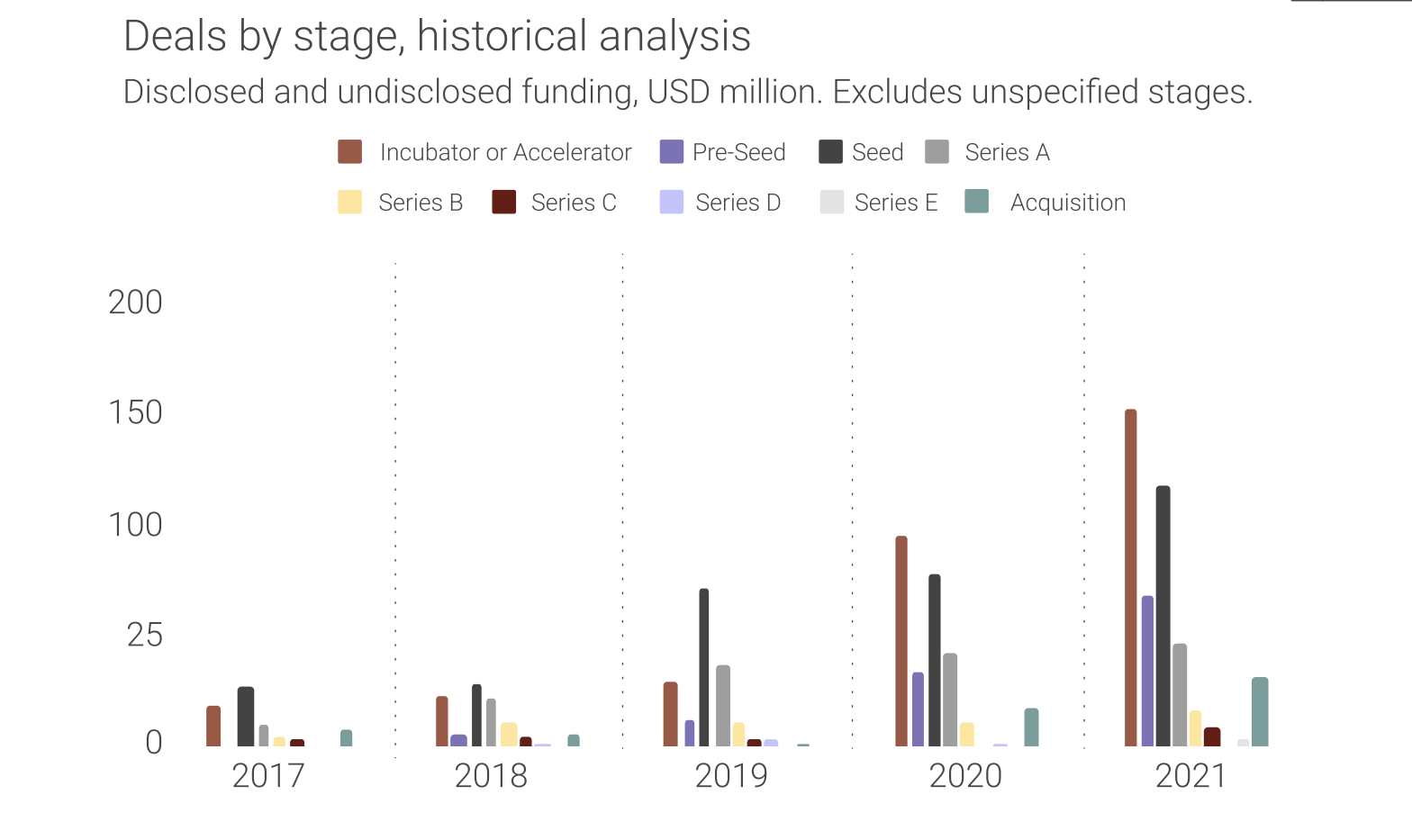
Deals by stage in Africa over the years. Image Credits: Briter Bridges

Startups specializing in digital/mobile payments have received the greatest financing over the years followed by banking/lending startups and insurtechs.  

The latest data shows digital payments space in Africa has also experienced the greatest growth in terms of funding received and total transactions volume over the last decade when compared to other sub-sectors within the fintech space. The growth experienced by fintechs is against the backdrop of the increasing phone ownership and a deepening penetration of mobile money technology and the internet – all of which have made it possible to bypass the sometimes restrictive traditional banking infrastructure.  

Innovations around mobile money and digital payments have allowed for the processing of payments online and offline through USSD or STK commands, over apps or using NFC technology.

“Africa has a massive underbanked and unbanked population, but its growing middle class, increasing mobile penetration and improving communications infrastructure make it uniquely conducive to fintech innovation and mobile financial services,” said Financial Technology Partners.

Emerging fintech services have banked the unbanked, driving up financial inclusion as their uptake solves some of the greatest pain points experienced by businesses and individuals– like sending and receiving money, and accepting payments. Startups in the remittance space like Wari, sureRemit and Paga, have, for example, made it possible for African residents to receive money from overseas easily and affordably. 

Image Credits: Getty Images

Opportunities for growth

Africa is regarded as the world’s second-fastest growing and profitable payments and banking market after Latin America, according to this McKinsey study, and this only means that the fintech sector is likely to continue to attract investors tapping on the increasing growth opportunities.

The continent is already a global leader in mobile money adoption, accounting for the bulk of the mobile money transactions made in 2020 – a year that saw the number of mobile money accounts rise by 43%.  Mobile money success across the continent is likely due to ease in access brought by advancements in telecommunications technology.

For instance, M-Pesa, a mobile money service by East Africa’s biggest telco, Safaricom, does not require internet connectivity for its customers to send and receive money, as well as to pay utility bills – the wallet turns subscribers’ phone numbers into a sort of proxy for bank accounts. The service recently surpassed voice to become Safaricom’s top earner after the platform’s revenues hit $745 million for the financial year ending March 2021.

Across the region (especially in Kenya) M-Pesa has served as an anchor for a raft of new services that are coming online. In 2012, for example, Safaricom laid the ground for the adoption of lending apps when it first launched M-Shwari – a mobile-based savings and loans product. Many more lending apps have since emerged in the market including Silicon Valley backed Tala and Branch. These now-popular lending apps use customers’ mobile money transaction history to determine the amount of instant credit to extend to borrowers – monies that are then deposited in customers’ mobile money wallets.

Such lending and banking startups have made credit accessible to a majority of people with no credit scores, and who were previously cut out by formal financial institutions due to a lack of banking history data.   

Insurtechs have also over the last few years thrived with the birth of innovative products that are affordable, allowing micropayments, and covering growing risks including those brought by climate change. Innovative products around insurtech have also encouraged the uptake of insurance products – even though the penetration across sub-Saharan Africa (with an exception of South Africa) remains low compared to other regions.

While investments grew in 2021, the bulk of the funding went to a small number of startups. Analysis by Briter, which includes data from both disclosed and undisclosed deals, shows that an estimated $3 billion of the total amount raised went to 20 companies, as over 700 other startups raised nearly $2 billion.


via Tingle Tech

Organizing information from providers, insurers and patients not only takes a lot of time, but increases private healthcare costs. Smarter Health, a Singaporean-based startup, develops technology that allows smoother exchange of data between different parties in the healthcare system, improving patient care and reducing administrative costs. The company announced today it has raised a $5.15 million SGD (about $3.8 million USD) Series A led by East Ventures for product development and to expand in Southeast Asia.

Other investors included Orbit Malaysia, Citrine Capital, HMI Group and Emtek.

The company currently operates in Singapore, Malaysia and Indonesia, and plans to enter into new countries with its new funding. The new round brings Smarter Health’s total raised to $8 million SGD.

Smarter Health’s platform isn’t meant to replace legacy software already in use by its clients. Instead, it seeks to work with them, and reduce manual processes. The startup’s AI-based tech enables secure data exchanges (with patient consent) between healthcare providers, insurers and patients. This enables it to offer a roster of services. For payors and insurers, this includes a patient concierge that recommends specialists, schedules appointments and creates demographic profiles of policy holders. It also automates claims assessments, updates insurers about cases and makes the bill and claims adjudication process faster.

The company has three main customer categories: doctors, hospitals and insurers and other corporate payors, like AIA, Allianz and Prudential, which make up the bulk of its business.

For healthcare organizations and providers, Smarter Health offers specialist recommendations and patient registration tools, a load-levelling solution that shortens waiting times and digitized hospital admissions and claim submissions.

In a statement, East Ventures co-founder and managing partner Willson Cuaca said, “The COVID-19 pandemic has forced insurers and healthcare providers to reflect and re-strategize on their operations, catalyzing digital transformation. Smarter Health is here to make healthcare accessible, affordable and accountable by providing an AI-powered interoperable platform.”


via Tingle Tech

Koko Networks, a Kenya-based bio-fuel technology enterprise has extended its business to cover other fast-moving consumer goods, through a new tech platform that will capitalize on its established distribution networks in low-income neighborhoods.

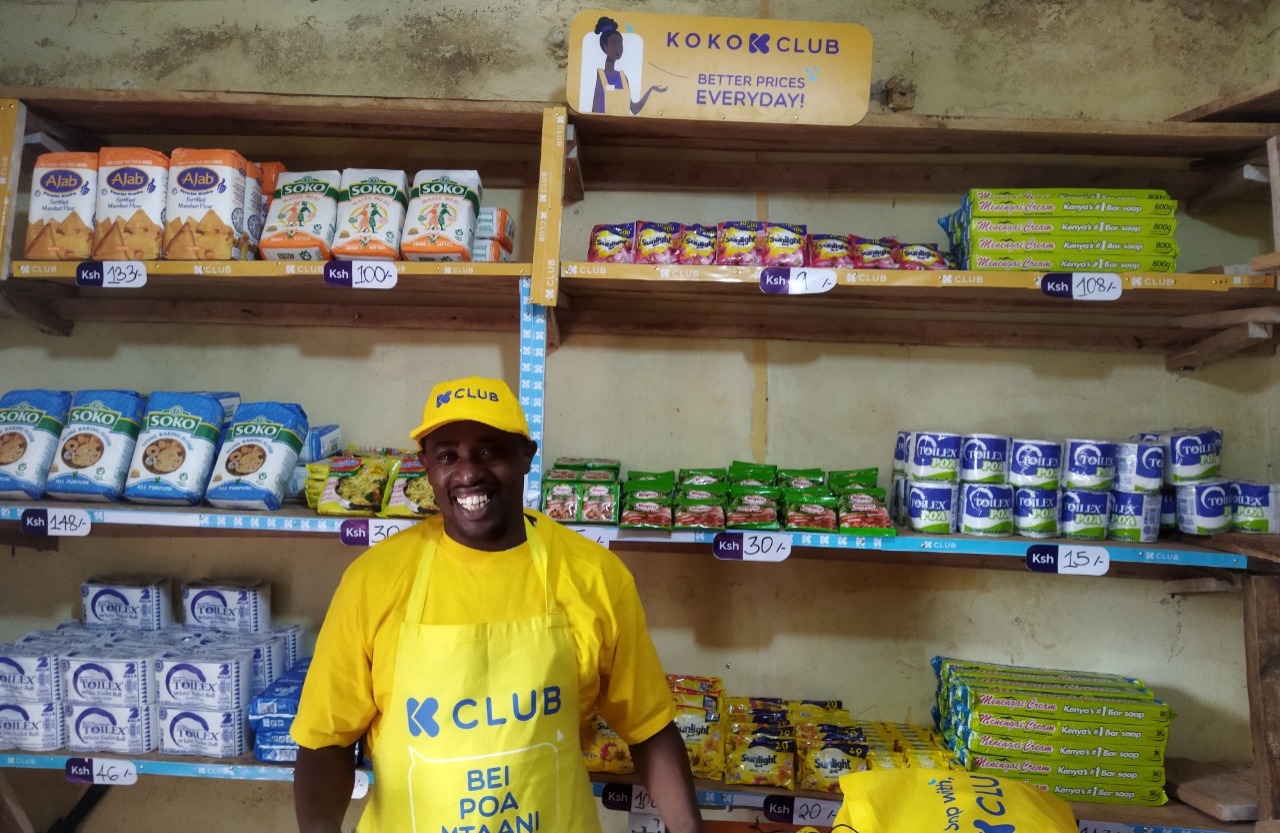
Koko Club, its new business-line, will sell the products directly to consumers through the dukas (small shops) that currently serve as the company’s agents for its bio-ethanol cooking fuel and stoves.

The Koko Club products, which will be displayed in designated spaces within the agents’ small shops, will only be sold to registered Koko Club members.

The shop owners (agents) will use Koko’s PoS system to sign up customers, capturing their biodata, and issuing them with an electronic card that they will use when buying products from any Koko Club shop.

The cards will be linked to an e-wallet, similar to the one currently used to purchase Koko’s bio-fuel, and which can be topped up via mobile money and other technologies.

Koko Club will source products directly from manufacturers and manage the inventory through a real-time management system that prevents stock-outs, in addition to providing accurate market analytics.

With 35 SKUs under its portfolio, initially, Koko Club will keep the prices of its products competitive by shortening the supply chains from manufacturer to consumers.

“We are targeting low-income households by bringing them the benefits of better products, lower prices and convenience. This is in addition to making sure that we have the right assortment of products all the time,” Koko Networks co-founder and chief innovation officer Sagun Saxena told TechCrunch. Grey Murray is the startups other co-founder and CEO.

Koko Club is a technology enabled retail platform targeting consumers in the low-income neighborhoods. Image Credits: Koko Networks

Micro-retail outlets, which account for 80% of sub-Saharan Africa’s household retail trade, are important for supplying consumers with groceries and other household items.

These informal retailers are usually located within a walking distance making them convenient to shoppers, with the added advantage of extending credit lines to loyal buyers.

The contributions of these informal merchants to economies, therefore, cannot be ignored as they account for the vast majority of trade in the retail sector across the continent.

These shops, however, continually suffer challenges like stockouts, variability in earnings, and inadequate financing making it hard for them to grow.

These are some of the gaps that Koko Club is planning to bridge, especially on the issue of stockouts — seeing that the agents do not require capital to restock.

Modernizing informal trade is regarded as one of the strategies for unlocking credit and the potential of these small micro-retail outlets as well as improving the lives of small business owners. Saxena said Koko Club’s business model gives manufacturers direct access to this market segment.

“Many of these manufacturers have armies of people that go into the neighborhoods to make sure that their products are being positioned properly and that these shops are styled. They even need to have people out there to figure out what prices the retailers are selling at,” he said.

“So, we take care of so much of that for them; we can tell them right now, exactly how many of their products are there and their price tags, and all that kind of information.”

The Koko Club idea was conceived mid 2020 but it wasn’t until the beginning of this year that the startup moved forward with its launch, riding on the success of its bioethanol fuel business, which was unveiled in 2019 as a cleaner, cheaper and safer alternative to charcoal and fuelwood.

Currently, there are over 300,000 households using Koko’s bioethanol fuel and stove (made in Koko’s plant in India) from about 100,000 in March this year. These households are served by the over 1,000 agents, who will now double up as Koko Club agents.

The Koko fuel business has in just over two years grown beyond Kenya’s capital Nairobi following a recent launch in the coastal city of Mombasa, with plans to enter Nakuru and Kisumu in the first half of 2022.


via Tingle Tech

Over the last two years, New Zealand’s startup scene has seen record venture and early-stage investment. Despite the pandemic, 2020 saw $158 million invested into 108 deals, representing the third year in a row of over $100 million in investment in startups. According to a PwC report, 2020 was also the third year of more than 20% year-over-year growth in dollars invested.

“Early-stage investment as an asset class is maturing in New Zealand,” Suse Reynolds, chair of New Zealand’s Angel Association, a network that connects angel investors to business owners, wrote in the PwC report. “A noticeable trend is that deal sizes are getting larger as early-stage ventures and angel-backed ventures scale and require larger quantums of growth capital.”

This boost in access to capital can be attributed to a few things. Even as a small country, New Zealand has a reputation for producing global companies, with notable exits like Vend, Seequent, Rocket Lab, Pushpay, Aroa Biosurgery, LanzaTech and Xero garnering the attention of foreign investors — like Founders Fund, Sequoia, Horizons and Aspect Venture Partners — who are either investing into local VC funds or directly into startup rounds. Those exits are providing returns, which investors are putting into other early-stage New Zealand startups to keep the ecosystem healthy and churning.

In fact, in 2020, investors provided more follow-on capital than ever before, which shows a commitment to support startups as they scale, grow and hopefully exit — a sign of a maturing investment scene, according to Young Company Finance deal data.

One of the biggest catalysts of the increase in VC investments, however, has been the Elevate NZ Venture Fund, a $300 million fund of funds program that will invest capital into VC firms over the next five years.

I’m hopeful over the next five years we’re going to start seeing more unicorns and real successes coming out of the market, which I think will create a positive halo effect and that’ll create the next generation of founders. Elevate Acting CEO James Pinner

As the country that’s probably best known for producing dairy and being the place where “The Lord of the Rings” was filmed starts to pursue technology as its next big export, it’s worth mapping out the funding landscape as it stands today, and what is expected of it in the future.

Note: All monetary amounts are listed in New Zealand dollars unless otherwise stipulated. 

Elevating Kiwi startups into scale stage

New Zealand’s government established the New Zealand Capital Growth Partners (NZGCP) in 2002 as an initiative to stimulate the early-stage startup ecosystem. After about 18 years of smaller-scale projects, the entity came up with the Elevate fund, and that might just be what gets today’s New Zealand early-stage startups into the next phase.

Elevate launched in March 2020, just as the entire world was locking down. To date, about half of the $300 million has been invested into six VCs to fill the Series A and B capital gap in New Zealand. One major stipulation of receiving funding from Elevate is that VCs have to raise matching capital from other investors that is at least equal to the government’s commitment. The goal is to stimulate $1 billion of investment into early-stage New Zealand businesses over the next 14 years, preferably from sources outside NZGCP.

Peter Beck, founder and CEO of Rocket Lab, served on the business advisory council on this project and would have liked to see a caveat in the stipulations that would limit funding eligibility to VCs that managed to bring in international venture capitalists to match Elevate’s investment.

While that caveat didn’t make it into the final language, Elevate did end up enticing some foreign VCs across the pond.


via Tingle Tech

New Zealand, a country of just under 5 million people, has historically flown under the radar of venture capitalism. A geographically isolated country with a “no worries!” culture and an economy based on raw materials, Aotearoa hasn’t stood out to investors in the Asia-Pacific region, especially not when they could set their sights on larger markets in China and Southeast Asia.

Now, investors see New Zealand as a country with a track record of building companies with global exits in SaaS, health tech and deep tech. Notable companies and exits like Xero, Pushpay, Aroa Biosurgery, Vend, Seequent, Halter and Rocket Lab have put local startups on the map, but the scene is still immature and will need steady direction before it becomes a globally competitive ecosystem. That said, the signs are all pointing to technology being New Zealand’s next export industry, as long as everyone keeps pushing in the same direction.

“For a very long time, startups in New Zealand had been crying out for capital,” said Imche Fourie, co-founder and CEO of Outset Ventures, a deep tech incubator in Auckland that invests in seed and pre-seed science and engineering companies. “That’s changed so much the last couple of years partly because the government’s been putting more initiatives into attracting international capital. It’s been ridiculous how much money is flooding into the country at the moment.”

Despite the pandemic, venture and early-stage investment in New Zealand is reaching record highs. In 2020, VC investments totaled NZD $127.2 million (USD $86 million), up from NZD $112.2 (USD $76 million) in 2019, due to a near doubling of transactions from 46 in 2019 to 92 in 2020. According to Crunchbase, money raised by New Zealand startups increased 30%, from around $1 billion to $1.3 billion, from Q1 2020 to Q4 2021. In addition, in 2020, investors provided more follow-on capital than ever before at 56%, or NZD $109 million (USD $79 million), which shows a dedication to supporting startups through to exit, according to a PwC analysis.

New Zealand investors say most of the money is coming from either international (mainly U.S. or Australian) VCs or the government. Last March, the New Zealand government launched the Elevate NZ Venture Fund, an NZD $300 million (USD $203 million) fund of funds program that invests into VC firms aimed at filling the Series A and B capital gap for high-growth New Zealand tech companies.

I don’t think it’s reasonable to expect the next Microsoft to be headquartered in New Zealand. But the next Microsoft may have offices here and it still might be founded by Kiwi. Rocketlab CEO Peter Beck

The fresh capital signals a shift both in the country’s economy and mindset around diversifying its exports and strengthening GDP at a time when the cost of living is quickly becoming unsustainable for many Kiwis.

Housing prices in New Zealand are among the most unaffordable among OECD nations, and an active supermarket duopoly sees Kiwis spending the fourth-most per capita on groceries in the world. Not to mention the banking and electricity oligopolies running the country. Taken together, you’ve got a society primed for wealth inequalities.

For a country with limited resources that relies on trade, developing thriving tech exports may not just be a good idea — it may be a necessity to survive.

“We’ve long had a strategic focus in New Zealand on moving away from commodity exports like timber, wool, milk powder, and attracting more value for what we export,” Phoebe Harrop, an associate at Blackbird Ventures, a New Zealand and Australia-based VC, told TechCrunch. “Technology startups are the pinnacle of that strategy. And it’s something we should be good at because we have a really good education system and we have this unusual cultural dynamic of people going out and spending time overseas in Silicon Valley, London, Amsterdam, Berlin, getting world-class experience, and then usually wanting to return home and do something here.”


via Tingle Tech

Brazilian construction tech startup Ambar announced it has raised a large Series C round: R$204 million, approximately $36 million at today’s mid-market rate. The round was co-led by Brazil-based Echo Capital and Oria Capital, with participation from TPG Capital, Argonautic Ventures, and others.

Ambar was created in 2013 with the ambition to leverage technology to make the civil construction process more efficient. According to the company, it has raised R$360 million in equity funding to date. That’s some $100 million, CEO Bruno Balbinot estimated.

This $100 million figure is higher than the current equivalent of R$360 million in dollars, but the exchange rate has varied quite a bit over the years, so figuring out that number isn’t straightforward. And on the other hand, it doesn’t account for the fact that the company also raised venture debt.

Regardless of the exact tally, the gist is that Ambar now has a significant amount of capital to execute its plans. Talking to TechCrunch, Balbinot explained that the startup plans to use the proceeds to boost the digitization arm of its business, for which it sees a strong need across Latin America.

While Spanish-speaking Latin America is driving some of its revenue, it is Brazil where Ambar is most present, Balbinot said. The startup’s home country presents two advantages: It is the region’s largest market, and Brazilian Portuguese acts as a moat against competitors.

According to Ambar’s site, it has 467 active clients. Three of these are located in the U.S., but its presence there is more of a learning experiment, Balbinot told me. In contrast, it is currently present on 1,500 building sites across Brazil.

Ambar has two sides to its business: digitization, which it is now planning to boost further, and industrialization, which some media outlets have likened to Lego for the construction sector.

Ambar is not a general contractor, though. “Our angle is to partner with those who construct, and we will never construct,” Balbinot said in Portuguese. Rather than simply claiming that Ambar is a tech company, he backs it up with its unit economics, which are “much higher than in the construction sector.”

Balbinot and his co-founder Ian Fadel have an unexpected source of inspiration: the automotive industry. Having both worked in connection with Volkswagen, they hope to bring the same kind of process-driven approach to the construction sector.

Transforming the construction business to make it more efficient also happens to make it more sustainable. By optimizing human and material resources, Ambar is reducing waste, which is a huge byproduct of traditional construction.

This is an issue its latest investors are committed to. Oria Capital is a B corporation, and the Environmental, Social, and Governance (ESG) section of its site explains that “Oria’s portfolio aims to contribute with the main Sustainable Development Objectives proposed by the UN.”

In addition, the Series C round was co-led by Echo Capital, the newly formed growth fund of Ambar board member Guilherme Weege, who has ties to the United Nations Global Compact initiative. The CEO of fashion group Grupo Malwee, he is one of the business leaders who signed the initiative’s Business Ambition for 1.5°C commitment.

Both funds also have portfolio success stories that Ambar would like to emulate. Weege’s family office backed Infracommerce, a Brazilian company that recently IPO’d on the Novo Mercado segment of São Paulo’s B3 stock exchange. As for Oria, its third fund of $100 million financed a follow-on investment into Zenvia, which went public on the Nasdaq last July.


via Tingle Tech

Zillow has updated its iOS 15 iPhone and iPad apps with SharePlay support, letting you browse homes with other people on Facetime, the company announced. iOS users can start a group FaceTime call and then enable SharePlay to browse through Zillow’s photo galleries so everyone on the call can see the property.

“Americans love to Zillow surf — most of them alongside someone else — and now they have a new way to do it,” according to Zillow. “Using the Zillow app on an iPhone or iPad, home shoppers are now able to search and browse for-sale home and rental listings in a seamless, synchronous experience together with family, friends or a real estate agent.”

Zillow said that 86 percent of users browse homes with a partner, spouse or housemate, so the new feature makes sense if you can’t be together in person. It’s also a “great new way for real estate agents to connect with customers,” said Zillow CTO David Beitel.

To use the feature, each participant will need Zillow running on an iPhone or iPad with iOS/iPadOS 15.1 or later. Users can search for different locations on Zillow and browse through available listings with content synced up. A rival real estate app, Redfin, introduced a similar feature back in October.

Editor’s note: This article originally appeared on Engadget.


via Tingle Tech

Amazon is seeking Indian antitrust watchdog’s approval to buy Catamaran Ventures’ stake in Prione, which operates one of the largest sellers on the e-commerce platform, months after the two firms said they won’t renew their joint venture after May next year.

The announcement comes as a surprise as Catamaran owns 76% stake in Prione. Amazon earlier held 49% stake in the company, but diluted it down to 24% to comply with the local laws that prohibit e-commerce firms from having a direct or indirect ownership in businesses that sell on their marketplaces.

In a joint statement Wednesday, the two firms said they are complying with the applicable laws “including all assets and liabilities” to close the deal and have sought the regulatory approval. Amazon has reached out to the Indian watchdog Competition Commission of India for the approval, a person familiar with the matter said.

Billionaire N.R. Narayana Murthy’s Catamaran and Amazon launched the joint venture in the country in 2014. The joint venture restructured its ownership in 2019 following India’s regulatory changes. In August this year, the two said they were ending the relationship.

That announcement came after news agency Reuters reported, citing Amazon documents, that the American e-commerce firms had given preferential treatment for years to a small group of sellers including Cloudtail and had used them to bypass Indian laws. The Competition Commission of India, separately, ordered an investigation into Amazon and Flipkart last year for allegedly promoting select sellers (those in which they own a stake) on their e-commerce platforms and using business practices that stifle competition. The two firms made an unsuccessful attempt to dismiss the investigation.

“The businesses of the joint venture shall continue under the leadership of the current management and on receipt of regulatory approvals, the board of Prione and Cloudtail will take steps to complete the transaction in compliance with applicable laws,” the joint statement from Amazon and Catamaran said today.

Cloudtail is one of the largest sellers on Amazon in India. It has enabled over 300,000 sellers and entrepreneurs to go online and provided 4 million merchants with digital payment capabilities, the two firms said earlier this year.

Long-standing laws in India have restricted Amazon and other e-commerce firms from holding inventory or selling items directly to consumers. To bypass this, firms have operated through a maze of joint ventures with local companies that operate as inventory-holding firms.

India got around to fixing this loophole in late 2018 in a move that was widely seen as the biggest blowback to the American firm in the country at the time. Amazon and Walmart-owned Flipkart scrambled to delist hundreds of thousands of items from their stores and made their investments in affiliated firms way more indirect.

In June this year, India proposed even tougher e-commerce rules that, among other things, prohibit Amazon, Flipkart and other e-commerce players from running their in-house / private labels. The new proposal asks e-commerce firms to ensure that none of their related and associated parties are listed on their platforms as sellers for selling to customers directly. (New Delhi has yet to follow up on the new rules.)

Amazon has stakes in a few more third-party sellers, including Appario Retail, which is its joint venture with Patni Group.


via Tingle Tech

Veho, a startup applying technology to next-day package delivery, aims to solve the last mile of delivery — how packages get from fulfillment centers to the customer’s door. It also wants to do it with a unique flair: providing transparency into deliveries that starts with the option of when, where and how customers want their packages delivered and then real-time communication throughout the whole process.

Since raising its seed round in the summer of 2020, New York-based Veho has grown 40 times in revenue, while also increasing its employee count from 15 to 400, Veho co-founder and CEO Itamar Zur told TechCrunch.

It is already working in 14 U.S. markets, but plans to grow to 50 markets by the end of 2022. To do that, and invest in technology development, growing the team and introducing and scaling its doorstep returns program, the company announced $125 million in Series A funding that valued the company at $1 billion.

General Catalyst led the round and was joined by Construct Capital, led by Rachel Holt, Bling Capital, Industry Ventures, Fontinalis Partners and Origin Ventures. The latest funding round gives Veho a total of $130 million raised to date, Zur said.

You might be asking yourself why in the world a young company would take on so much capital up front like that, but Zur responded that Veho is “a substantial platform, not a small operation at this point, and we want to maintain fast growth.”

“We have an opportunity in the midst of the biggest e-commerce revolution, and after growing fast through the pandemic, that is not going away,” he added. “Customer experience is changing in front of our eyes, and other than speed and communication, what brands want to provide is visibility and data. We think it is the perfect time to take in more capital to continue to grow at a phenomenal rate.”

Sure, Amazon has a bear hug on about 50% of the last-mile market, and there is no debate that they are doing well here. Zur doesn’t deny it either, but he does see an opportunity to offer the same kind of delivery service for the 50% of e-commerce businesses that want to offer something faster than seven to 10 business days.

Veho’s technology matches package delivery demand with qualified driver partners and can then let customers know the actual time of day when they will receive their package and even when the driver is headed their way. It is also making it possible to reschedule a delivery in real time, change an address or provide personal delivery instructions.

Veho

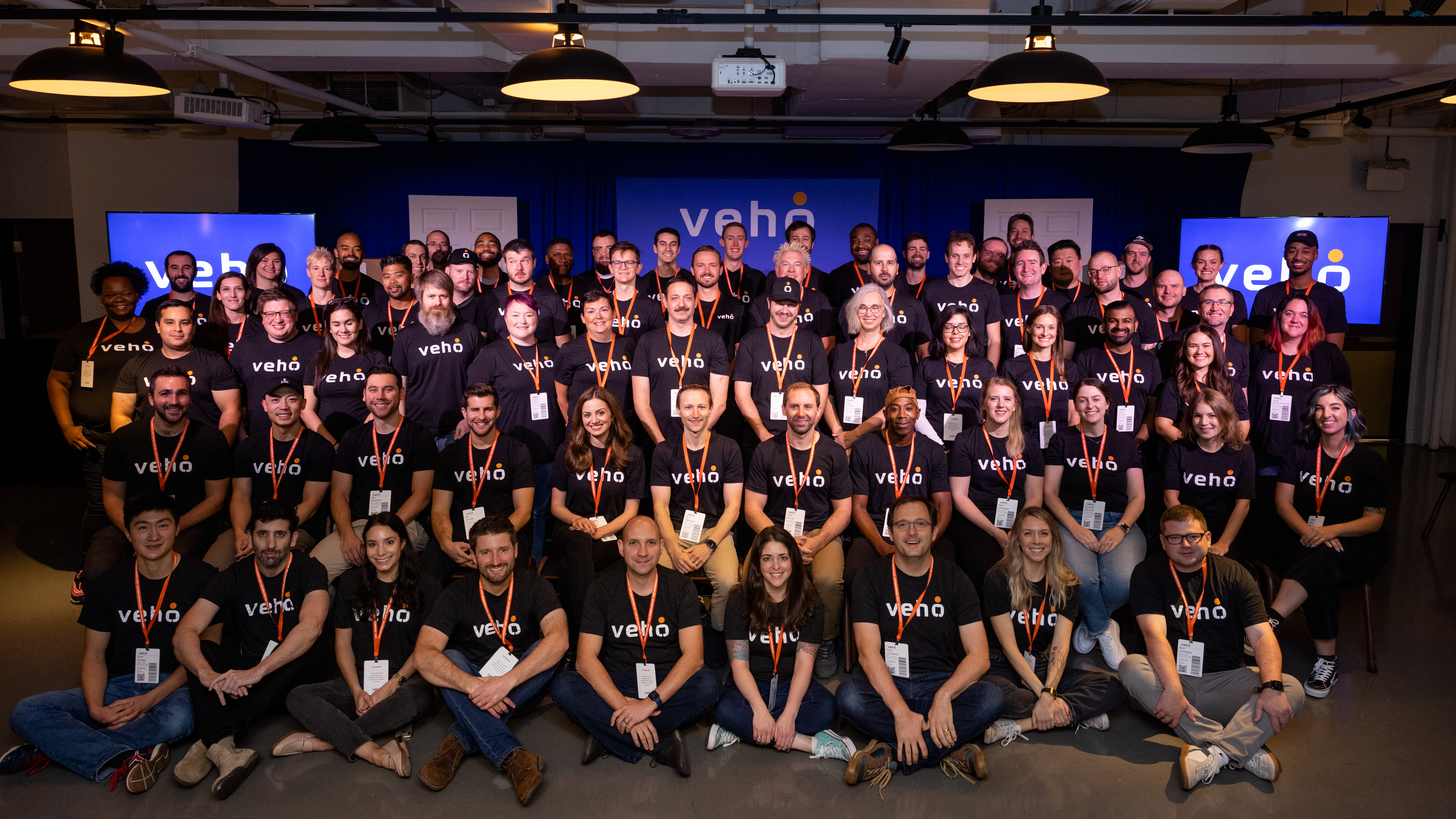
The Veho team. Image Credits: Veho

The idea for the company stems from Zur’s own experience. While in business school, he bought a subscription for meal delivery, but his first package never arrived. Zur recalls trying to get in touch with the delivery company, and after waiting for 40 minutes, the call was disconnected. As a result, he canceled the subscription, which is not unlike what other consumers do as they become more intolerant of receiving packages late or not at all.

“In an increasingly competitive e-commerce space, there are tons of companies looking for similarly fast delivery as Amazon, but lack the scale to do it,” Zur said. “Veho levels the playing field for these brands. The biggest missed opportunities are connecting the dots between the pre-packaged experience and delivery to help brands build more loyalty and for people to stay with them longer, to buy more and buy more frequently.”

Veho is not alone in trying to solve the last-mile problem, and is among companies around the world also raising capital for their approaches. For example, in the past six months, we saw Zoomo, Cargamos, Coco, Deliverr and Bringg announce new rounds. Walmart also introduced its Walmart GoLocal program in the summer for other retailers to tap into the retail giant’s delivery network.

Zur doesn’t see Veho competing against the likes of Deliverr or some of those others, but does see the company competing with the national shipping companies. He believes their technology was designed for “an older world” that didn’t include e-commerce, and that is what separates Veho from them — that it was built “entirely around the needs of e-commerce customers” with a vision of how that sector will grow over the next decade.

The global last-mile delivery market was valued at around $108 billion in 2020 and is set to grow by $146.96 billion in the next four years, with North America contributing to 39% of that growth, according to technology and research company Technavio.

With purchases shifting to e-commerce, the logistics and parcel delivery sectors are racing to keep up with demands. They’ve also been met with major setbacks in the past few years. From the aptly dubbed “shipaggedon” during the holiday season in 2020, to manufacturing and shipping delays for everything from semiconductors to getting a ship into the port.

Veho wants to make the delivery experience so awesome that it facilitates trust between the consumer and e-commerce company so that consumers return to order again. Zur notes this is already happening, citing that its customers, which range from selling apparel and accessories to food and packaged goods, saw a 20% increase in customer repurchase, 40% increase in customer lifetime value and an eight-point increase in net promoter score compared to customers who received their box from a traditional shipping company.

Meanwhile, Kyle Doherty, managing director at General Catalyst, said there is room for more companies going after an $800 billion e-commerce market, of which half stems from the U.S., and that is forecasted overall to grow around $100 billion each year.

Like Zur, Doherty had his own frustrations receiving packages at his home in San Francisco, which he said is notorious for having problems with package thefts.

“You feel helpless and that you’ve lost control of the situation,” he added. “We have had a front-row seat to the dramatic acceleration in the use of e-commerce and a stressed supply chain. We had a belief that computer technology would enable logistics providers to provide a better experience. When I was introduced to Ita, I got it instantly. He also has empathy for merchants and consumers about the consumer experience, and that stood out on many fronts.”


via Tingle Tech

Fintech startup LiveFlow has raised a $3.5M Seed round which was led by Moonfire Ventures with backing from Y Combinator, Seedcamp and WndrCo.  Also participating was Victor Jacobsson, co-founder of Klarna; Bradley Horowitz, former VP Product at Google; Oliver Jung, former VP International Expansion at AirBnB, Phillip Chambers, Peakon founder & CEO, and others.

LiveFlow allows companies to sync real-time data from their accounting services, banks, and payment platforms into their custom reports, thereby automating workflows, consolidating company accounts, and allowing more company-wide collaboration.

Founded almost a year ago by CEO Lasse Kalkar and COO Anita Koimur (ex-Revolut), and CTO Evan O’Brien (ex-Web Summit), LiveFlow has most of its customers in the US, such as accounting firms like Ascent CFO, CFO Minded and TinyCFO – as well as a handful of startups from Y Combinator.

Lasse Kalkar, co-founder and CEO, LiveFlow said: “In my previous companies, I felt the frustration of manually pulling together financial reports. That’s where the idea for LiveFlow came from.”

Mattias Ljungman, founder and managing partner at Moonfire Ventures said: “LiveFlow provides a critical service by automating and streamlining the reporting process, giving businesses the visibility and real-time information they need to better manage their business.”


via Tingle Tech

Some 55 billion parcels are shipped in bubble wrap every year. Plastic bubble wrap is reliant on fossil fuels and 98% of plastic packaging is single-use. You can imagine the adverse environmental impact of all this plastic.

The founders of Woola were running an online e-commerce store and saw the packaging problem first-hand. The lack of options in sustainable and scalable protective packaging led to them re-discovering wool — an unused resource that is elastic and regulates temperatures and humidity.

The result was their startup, which uses leftover sheep wool to replace bubble wrap. These wool-based packages can be reused, repurposed, or returned by the end-user, with the ultimate goal of making the solution ‘closed-loop’ so nothing goes to waste.

Woola opened a production facility in Estonia and launched its first product in December 2020. Wool envelopes were the first products to hit the market. It’s now expanding to the UK, France and Germany. The next product rolling out in January 2022 is targeted at beverage companies.

They’ve now a raised €2.5M Seed round led by Future Ventures. Future is joined by co-investors Kaarel Kotkas (CEO at Veriff), Janer Gorohhov (Co-founder at Veriff), Kristina Lilleõis (VP of People at Veriff), Zem Joaquin (founder of Near Future Summit), Bryan Meehan (executive chair of Blue Bottle Coffee). Woola’s previous investors include the co-founders of Pipedrive, Bolt and the angel fund Lemonade Stand.

“Bubble wrap has been dominating the packaging industry for ages – but its decline is inevitable,” said Woola’s CEO and co-founder Anna-Liisa Palatu. “The industry is broken for two reasons: fossil fuel reliance and single-use mindset. We need to get rid of both to make packaging more sustainable.” She is joined by co-founders Jevgeni Sirai and Katrin Kabun.

Steve Jurvetson from Future Ventures commented: “While e-commerce is booming, single-use plastic packaging is out of control. Woola can replace it all with beautiful envelopes made from scrap wool that would otherwise be burned or buried. The world needs sustainable alternatives to the petrochemical economy for a healthier future.”

Sheep wool is an unused resource – more than 200,000 tonnes of wool is thrown away in Europe yearly. Woola says this is enough to fulfill 120% of the global bubble wrap demand.

The startup will compete with whitelabel plastic bubble wrap and alternatives like Ranpak and S-Packaging.


via Tingle Tech

Planet42, a South Africa-based car subscription company that buys used cars from dealerships and rents to customers via a subscription model, has raised $30 million in equity and debt.

The investment — which co-founder and CEO Eerik Oja called a bridge round — is a prequel to a larger Series A round next year. It comprises $6 million equity and $24 million in debt financing. 

The company raised $2.4 million in a seed round in June 2020 and followed it with $10 million in debt from emerging markets-focused venture debt fund Lendable in December. The fund doubled its participation in this recently raised debt round at $20 million, while other investors completed the rest.

Naspers, through its early-stage investment vehicle, Naspers Foundry, led the equity round with $3.4 million. Existing investors include Change Ventures, the lead investor from Planet42’s seed round, as well as Startup Wise Guys, Martin and Markus Villig of Bolt, and Ragnar Sass of Pipedrive.

Planet42, though based in South Africa, has Estonian roots due to the founders’ heritage: Oja and CFO Marten Orgna founded the company in 2017. In an interview, Oja mentioned that they created the car subscription model to cater to private individuals ignored by South African banks when they need vehicle financing.

“Our car subscription [model] is socially inclusive. For us, the differentiating factor is our customers would not have a car without us,” Oja said, adding that because the company is buying second-hand cars, the unit cost is lower compared to a subscription model that purchases new cars.

It can be challenging to get a personal car in most emerging markets, especially if one’s income isn’t stable. And without a good credit history, lenders tend to ignore people with bad credit or give them unfavorable interest rates for vehicle financing.

Planet42 is one of the few upstarts focused on the African market tackling this inequality via a car subscription offering. The company claims to use proprietary scoring algorithms superior to traditional credit scores in assessing risk in underbanked customer segments.

The company has over 700 dealerships. And with its algorithms, customers can find out what budget suits them and choose new or pre-owned cars from Planet42’s dealerships network.

After that, Planet42 buys the car and rents it out to the customer on a subscription basis. Planet42 claims that of all the customers served so far, 89% would have had no other means of gaining access to a personal vehicle.

“We’ve gotten so good with our scoring that we can now enable the customers who couldn’t get bank financing to get a brand new car. We have figured out a way how to do it sustainably that we can put entry-level brand new cars in the hands of the same target market and customers who are unfairly ignored by banks,” the chief executive said.

Four years later and $50 million in equity and debt raised later, Planet42 has listed more than 7,000 cars to customers in South Africa. This number was 3,000 when Oja spoke with TechCrunch in March, and he noted that the company grew 25% month on month in 2021.

Planet42

Planet42 founders (Marten Orgna and Eerik Oja)

Autochek and Moove are other companies offering similar services in parts of sub-Saharan Africa. While Moove focuses on financing ride-hailing cars, Planet42 and Autochek services are targeted at private individuals. Planet42 has a cohesive network of automobile industry stakeholders on its platform.

Both Moove and Autochek have made inroads into other African countries after initially launching from Nigeria. But for Planet42, the next attractive market lies off the continent. 

“We’re just not doing it right now, but we’re not ruling it out for the future,” Oja answered on whether Planet42 would expand into other parts of Africa. “However, the main reason is market size. South Africa has like 25% of all the passenger cars on the African continent; that means that whatever market we go next in Africa will necessarily be smaller than South Africa. In South Africa, 1.1 million second-hand cars get sold and bought every year. In Mexico, that number is 7 million. So the Mexican market is six times larger than South Africa. So we want to go for the really big markets.”

The company said it has bought its first cars for clients in Mexico. Similar challenges stemming from transport inequality abound in the country, where 63% of the population deal with only cash.

But Mexico is one of the few countries Planet42 plans to expand to in the foreseeable future, said Oja, who also said that the company has set up an office and employed two staff.

He said the company hopes to have bought over 1 million cars for its customers across its present and future markets by 2025. Planet42 said it has also made strides in becoming a carbon-neutral company via a wind farm project in Northern Cape, South Africa. The car subscription company financed the farm for months with money from carbon offset credits.


via Tingle Tech

Contact Form

Name

Email *

Message *

Powered by Blogger.