Latest Post

Republicans want to punish Big Tech companies for removing content. Democrats would like to penalize Big Tech companies for not removing enough content.

It may seem like Congress is unified in their dislike for platforms like Facebook, Twitter, Instagram, and YouTube. Both Republicans and Democrats voice their displeasure for these companies, right to its executives' faces in hearing after hearing.

And yet, Republicans and Democrats could not be further from agreeing on the issue. This dynamic was once again on display at the latest Big Tech hearing.

On Wednesday, the House Subcommittee on Communications and Technology held a hearing titled "Holding Big Tech Accountable: Targeted Reforms to Tech's Legal Immunity."

The hearing's focus was on Section 230, a very important part of the United States Communications Decency Act which basically provides tech companies protection from legal liability due to what users post on their platforms.

Democrats and Republicans seek to change Section 230, albeit for their own specific reasons. However, the urgency of the situation has heightened in the weeks and months since Facebook whistleblower Frances Haugen shared internal documents showing just how harmful the social network is to young people, and that the company knows it. 

Congress has proposed multiple pieces of legislation such as H.R. 2154, the "Protecting Americans from Dangerous Algorithms Act," H.R. 5596, the "Justice Against Malicious Algorithms Act of 2021," and H.R. 3421, the "Safeguarding Against Fraud, Exploitation, Threats, Extremism, and Consumer Harms Act" or the "SAFE TECH Act." 

However, experts have issues with what's been proposed by Congress.

As the digital rights nonprofit Fight for the Future and others have pointed out, the legislation as its currently proposed would have the same stunning effects on a worryingly wide range of sites.

The future of platforms smaller than the Big Tech companies, ranging from well-known websites like Wikipedia to your favorite blogger, would be in peril. Broadly, the new legislation punishes sites for having recommendation software that algorithmically serves content that injures users emotionally — though exactly what qualifies as emotional injury is vague.

Without legal liability protections that Section 230 provides, many smaller platforms would most likely need to fundamentally change or outright shutdown after this change. Companies like Facebook, on the other hand, would likely be able to weather the storm of incoming lawsuits.

These bills are, according to Evan Greer of Fight for The Future, "misguided pieces of legislation that would alter Section 230 of the Communications Decency Act, a foundational law for online human rights and free expression."

Fight for the Future and other critics have long concentrated on the fact that marginalized groups who were most affected by the last change to Section 230, have been completely shut out of this very conversation.

In 2018, then-President Trump signed a bill, FOSTA-CESTA, that carved out an exception in Section 230 when it came to content relating to prostitution or consensual sex work. The fallout from the new law greatly hurt sex workers, educators, and others in the space as platforms like Instagram and TikTok removed a huge amount of sexual content.

The voices of the groups with these concerns were missing from the conversation today, although Facebook Whistleblower Frances Haugen, who was one of the witnesses at the hearing, did speak out on their behalf.

"Congress has instituted carve outs of Section 230 in recent years," Haugen said in her testimony. "I encourage you to talk to human rights advocates who can help provide context on how the last reform of 230 had dramatic impacts on the safety of some of the most vulnerable people in our society but has been rarely used for its original purpose."

Unfortunately, any chance for constructive dialogue at these hearings is usually thrown out the window as soon as Congresspeople get to their partisan pet issues. This hearing saw the usual diversion into a discussion about TikTok and China. One of the invited witnesses, Kara Frederick of the Heritage Foundation – a former Facebook employee – spent her time listing various conservative personalities who'd been suspended or banned from online platforms for breaking its respective site policies.

Maybe, sometime in the future, Congress will be ready to enact meaningful change that makes sure Big Tech conglomerates are held accountable while at the same time preserving the spirit of the internet for smaller platforms and users alike.

For now though, we're just going to get a lot more of these hearings. And not much else.


via Tingle Tech

Say hello to Block.

The company formerly known as Square Inc., which includes a host of businesses like Cash App, Tidal, and Square, announced a new blockchain-associated name Wednesday. In a press release explaining the change, what is now Block made clear that yes, its new name is — at least in part — an intentional nod to the technology behind Bitcoin.

"The name has many associated meanings for the company — building blocks, neighborhood blocks and their local businesses, communities coming together at block parties full of music, a blockchain, a section of code, and obstacles to overcome," reads the statement in part.

This emphasis on cryptocurrency shouldn't come as a surprise. Jack Dorsey, the former CEO of Twitter and current CEO of payment company Square Inc., is notoriously obsessed with crypto in general, and Bitcoin specifically.

Beyond that, however, the name change can be read as part of a larger tech-industry trend. Like Google and Facebook — two companies which restructured their sprawling corporate properties under the umbrella names of Alphabet and Meta, respectively — before it, Square Inc. becoming Block allows the company to disassociate its eponymous point-of-sale product from its other ventures.

Which, if the goal is to go all in on cryptocurrency, could help with any resulting public relations fallout. Because in essence, that's what this name change boils down to: public relations.

"The name change to Block distinguishes the corporate entity from its businesses, or building blocks," explains the press release. "There will be no organizational changes, and Square, Cash App, TIDAL, and TBD54566975 will continue to maintain their respective brands."

How disruptive.


via Tingle Tech

A new study claims that Amazon makes far more from fees on its Marketplace platform than even the cash cow known as AWS. The report says that Amazon’s fees for participating effectively on its store have grown to the point where sellers now give the company about 34% of their earnings — and this has lately become Amazon’s primary revenue stream. The company disputes the report’s findings.

The report, “Amazon’s Toll Road,” by the Institute for Local Self-Reliance, makes two primary claims. First, the ILSR’s researchers say that in 2021 Amazon will bring in some $121 billion from sellers in the form of fees and advertising payments, about 34% of those sellers’ total revenue. That’s twice the estimated $60 billion from 2019, which at the time was 31% of seller revenue, according to the report.

Founder Jeff Bezos himself attempted to counter this narrative when he told Congress that the increasing amount of money going from sellers to Amazon is something of an optical illusion, due to more of them choosing to pay for add-on services like better placement on keyword searches and using Amazon’s own shipping and warehouse infrastructure.

In a statement to TechCrunch, Amazon called the ILSR report “inaccurate,” saying it “conflates Amazon’s selling fees with our optional add-on services” and that its selling fees are competitive with other online retailers — and certainly the report does combine those numbers.

But as its author, Stacy Mitchell, points out, the add-ons have gone from optional to must-have as Amazon has given advantage after advantage to sellers that use them. Reports over the last few years show that the number of ads and sponsored listings on common product searches have increased dramatically. And Amazon gives a score bonus to sellers using the “Fulfilled By Amazon” service, which contributes strongly to whether a product gets certain coveted spots in the listings. And this is without considering the shady business of duplicating successful products.

Amazon did not address the claim that sellers are spending 4-5 times as much on ads and placement today as they did in 2016, contributing to the huge increase in income. The company merely said there is a range of ad types and processes, and that it’s “a great way for sellers to help increase the visibility of their products.” It denied that it favors FBA users in search results, though as the link above shows, it seems to do so by indirect means.

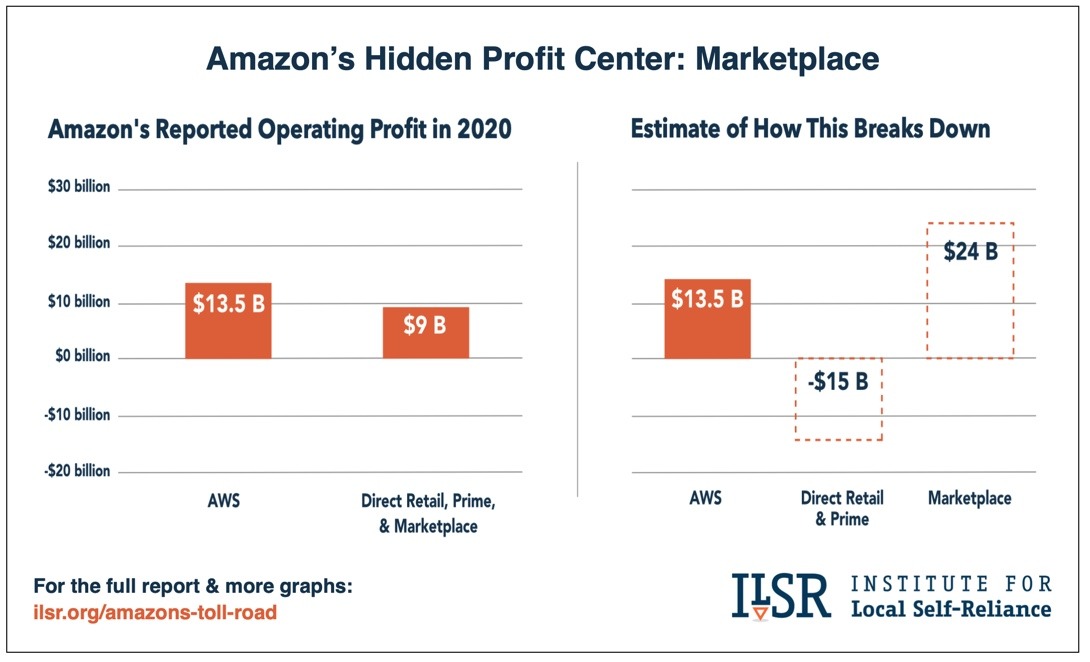
The other claim made by the report is that Amazon is using creative accounting to mask the enormous revenues generated by seller fees, grouping the huge profits of the Marketplace division with enormous losses incurred in building out their shipping infrastructure. Sure, they’re related — but it’s hardly forthcoming to present an aggregate of two wildly different numbers and claim it represents the business accurately. This is not a new allegation, but Mitchell puts specific numbers on it for 2020, making it more than a general idea.

A diagram showing how one aggregate number might misrepresent the actual profits and losses happening within Amazon.

Image Credits: ILSR

“We conclude that seller fees likely generate more profit than AWS. This contradicts conventional wisdom about the company; news stories commonly describe AWS as the source of most of Amazon’s earnings,” writes Mitchell in the summary. “Drawing on analysts’ estimates of the margins Amazon likely earns on seller advertising and other seller fees, we find that Marketplace may have generated operating profits of $24 billion in 2020 — significantly more than the $13.5 billion in profit that Amazon reported for AWS. AWS has long been seen as Amazon’s cash cow. But this report finds that the tech giant has a second cash cow, which it keeps quietly out of view.”

Amazon told me that it “cannot speculate” on 2021 revenue numbers during the year, but did not respond to a follow-up question asking whether the previous years’ numbers in the ILSR report were accurate.

Some of these practices are under scrutiny by various government powers, including an FTC led by perhaps now the world’s most famous questioner of Amazon’s business practices, Lina Khan. The ILSR report is merely informative and Amazon can wave it away, but if an FTC task force is looking into similar questions and drawing similar conclusions, the company may have reason to start sweating.


via Tingle Tech

To get a roundup of TechCrunch’s biggest and most important stories delivered to your inbox every day at 3 p.m. PST, subscribe here.

Hello and welcome to Daily Crunch for December 1, 2021! Yes, we’ve made it to the final inning of the year, which means that the news cycle will slow and we all get some time off? Right? Probably not, but in alternative good news, Brian Heater’s robotics newsletter launches tomorrow. It’s called Actuator and it is going to kick maximum backside. Snag it here!Alex

P.S. Blue Origin’s Ariane Cornell is coming to TC Sessions: Space 2021!

The TechCrunch Top 3

  • China may ban foreign IPOs: Big news from a leading startup market as reporting indicates that the Chinese government may block a method by which domestic tech companies are listed on foreign exchanges. Alibaba and others have used the technique, which opens the door for further economic and technological decoupling between China and the rest of the world.
  • Match settles with Tinder co-founders: Allegations that “IAC and its then-subsidiary Match Group had manipulated financial data” to put a low valuation on Tinder when it was folded into the larger company have been settled for more than $400 million. That’s a right bucket of duckets.
  • Taxpayer money to support Chinese surveillance? In a critical piece of reporting, TechCrunch’s Zack Whittaker writes that “at least three U.S. federal agencies, including the military, have purchased China-made video surveillance equipment banned from use in the federal government.” Not good!

Startups/VC

Before we dive into a bevy of discrete pieces of startup news, another 3D printing company is going public! Via a SPAC! This time it’s Austin-based Essentium. Recall that Desktop Metal went public via a SPAC previously. Its stock traded as high as $34.94. It is worth $6.08 per share today.

  • From coaching to SaaS: Providing coaching to corporate staff is big business, but it remains, at its core, a human game. That means modest margins. Sounding Board is moving from the coaching world into the coaching software industry, which helped it land a $30 million Series B. Jazz Venture Partners led the round, which is a firm I had not heard of before.
  • Butter wants to cut the churn: To avoid making an extensive butter/churn joke that would surely get cut before this newsletter reaches you, let it suffice to say that Butter, a startup, is in the anti-churn game. Yes, Butter doesn’t want you to have to churn all by yourself. See? Impossible to avoid. Regardless, the company just added $7 million to its accounts to help companies avoid losing revenue to payments issues.
  • What’s AI good for? A lot, it turns out. Our own Devin Coldewey has notes on how AI is showing promising signs as a solution for both protein generation and mathematics. Startups, take note!
  • And speaking of AI, Sydney-based Harrison.ai has raised $129 million (AUD) for its work to build medical tech using artificial intelligence.
  • Goalsetter is taking on youth financial literacy: Let’s be clear, most people are bad with money. This is for a number of reasons, including the simple fact that financial education in the U.S. is weak at best. Kid-focused financial platform Goalsetter wants to work on the matter by tying child access to allowances and the like to learning more about money.
  • Republic buys Seedrs: Republic helps private-market shares trade in the United States. Seedrs helped U.K.-based companies crowdfund equity rounds. Now, thanks to a $100 million deal, the American company will own the European concern.
  • Do you want a weed credit card? Buying legal cannabis is a pain in the neck in the United States, thanks to both historically racist laws and neo-Puritan forces. Regardless, SuperNet has built a credit card that will work for, and with, dispensaries. A small step, but a welcome one.
  • Nuro + 7/11 = autonomous deliveries in California: Yes, another week, another news item of a small-scale self-driving service making its way to market. While I am not sure that Slurpee delivery is the real killer app for autonomous delivery, I would try this out for no other reason than to encourage more of the same.
  • And if you need even more, the Equity crew recently dug into the matter of founders, CEO status and when a company might outgrow its progenitor as chief exec.

How to execute an amplified marketing strategy

Hand of hispanic man holding megaphone over isolated blue background.

Image Credits: AaronAmat (opens in a new window) / Getty Images

Every blog post, Tweet and Instagram Story is an opportunity to explain to customers (and the board) how the company creates value or is a step ahead of the competition.

But quality will always beat quantity when it comes to content marketing; Googlebot may be hungry for new links, but potential customers demand expertise and insights.

Marketers need a new plan of action that puts creativity before quantity, audience before engine, and sets connection as the top priority,” says Lindsay Tjepkema, CEO of audio and video content marketing platform Casted.

(TechCrunch+ is our membership program, which helps founders and startup teams get ahead. You can sign up here.)

Big Tech Inc.

Today is the day! Yes, it is Spotify Unwrapped 2021, which means that we’ve spent the afternoon posting to Twitter all about our excellent musical tastes. TechCrunch has more here on what’s new.

And, yes, even more from Amazon:

TechCrunch Experts

dc experts

Image Credits: SEAN GLADWELL / Getty Images

TechCrunch wants you to recommend growth marketers who have expertise in SEO, social, content writing and more! If you’re a growth marketer, pass this survey along to your clients; we’d like to hear about why they loved working with you.

If you’re curious about how these surveys are shaping our coverage, check out this article on TechCrunch+ from Marjorie Radlo-Zandi, “4 key strategies for succeeding at international expansion.”


via Tingle Tech

Snapdragon’s G3x is Qualcomm’s fantastically exciting bid to embrace the gaming market — a brand new reach for the manufacturer, which introduces powerful GPUs, 5G-enabled connectivity, the ability to power external screens, immersive audio capabilities, haptic feedback and a slew of other features that handheld gaming manufacturers have had to cobble together from other sources. Uniting all of this in a single platform is new — and might mean a renaissance of handheld gaming, unlike anything we’ve ever seen before. Razer today showed off a developer kit based on the new platform, kick-starting an exciting new era in handheld gaming.

The rapid development in mobile phone technologies have been unlocking new products in all sorts of categories for a couple of decades. People are now so used to iPads that we don’t accept crappy airline check-in kiosks anymore. We’re so used to excellent battery life and high-speed internet, that anything that falls short of it sparks impatience and frustration. Relatively affordable consumer-grade quadcopter drones only became possible when accelerometers and processors became cheap enough for consumer electronics tinkerers to take existing components and put them together in new and interesting ways.

The march of technology advances is never-ending — and it’s ever so exciting to see Apple launch its own ludicrously powerful processors, and when Google shows off the Tensor processors in the newest-generation Pixel phones, you’d better believe we lean in for a closer look. These are technologies that will have far-reaching impacts in the computing world, but they live in the siloed universes of Apple and Google respectively. Fun, sure, but where the real impact of new processors can be felt by the startup-loving readership of this very publication, is when the OEM manufacturers flex their vision for the future. In short — as a startup, you’re probably not going to be able to get your hands on an Apple M1 Max or a Google Tensor for your own hardware devices. The same isn’t true for Qualcomm and its Snapdragon silicon.

Qualcomm is in the unusual space of making processors that are powering the entire world around us. This is the technology that’s going to be powering everything from fridges to cars to drones to … well, anything you can possibly imagine, really. SnapDragon 8 lives in smartphones across the world. The 4100+ platform powers wearables. XR2 with its 5G chipset is going to be doing the heavy lifting for AR/VR applications. The 8cx processors will be living in tablets and PCs — and we’ve seen the Snapdragon Ride platform turn up in cars. Seeing Qualcomm taking a serious look at the gaming market is interesting, taking deep niche products like the Nintendo Switch and giving hardware manufacturers a toolkit to build their own, powerful handheld gaming console platforms.

More than just tossing together a pile of chips and wishing console developers a happy journey, Qualcomm made the ever-so-shrewd move to partner with gaming veteran Razer to build a developer kit, so software developers can start getting busy while the hardware manufacturing world spools up its product development afterburners.

The Snapdragon G3x Gen 1 Gaming Platform delivers cutting-edge performance and the entire arsenal of Snapdragon Elite Gaming technologies to run all Android games, play content from cloud gaming libraries, stream games from a home console or PC and much more. Available today, the platform is a battle cry for market dominance — and it’s going to be spectacularly interesting to see this one play out.

The Razer/Qualcomm collaboration for a developer kit looks like a hell of a handheld gaming console. Image Credits: Qualcomm

The platform has a lot that is particularly interesting, including:

  • The Qualcomm Adreno GPU, which promises 144 frames per second and 10-bit HDR for gaming in over a billion shades of color.
  • A built-in 1080p60 webcam with two microphones for livestreaming the gaming action to audiences.
  • A full battery of connectivity options using Qualcomm’s FastConnect 6900 Mobile Connectivity suite. That means Wi-Fi 6 and 6E for low latency and fast upload and download speeds. 5G mm Wave and sub-6 for cloud gaming while streaming the most bandwidth-intensive games from services like Xbox Cloud Gaming or Steam Remote Play.
  • Incredible display: 6.65-inch OLED display with Full HD+ resolution and 10-bit HDR, operating at up to 120 hz.
  • Snapdragon Sound technology, optimized for quality, latency and robustness, giving gamers the option to pinpoint opponents aurally. On-device 4-way speakers provide fantastic audio and when paired with Snapdragon Sound-enabled earbuds, gamers can experience lag-free wireless audio.
  • Multiscreen experience can tether to an AR/VR viewer via USB-C. The same tech also enables the device to act as a companion controller to a TV with up to 4K resolution.
  • Controls: The developer kit has built-in controller mapping from AKSys to provide precise touch to controller mapping technology to enable use of the built-in controllers across a wide array of games.

“Razer is extremely excited to partner with Qualcomm Technologies and support them on their way to introduce new cutting-edge technology to the global gaming industry,” says Min-Liang Tan, Razer co-founder and CEO. “Together, Qualcomm Technologies and Razer will lead the way with new and innovative solutions that push the boundaries of fidelity and quality available in portable gaming, transforming the way these games are experienced.”

You can find out more about the Snapdragon G3x Handheld Developer Kit on Razer.com


via Tingle Tech

Spain’s Jobandtalent, a “workforce marketplace”-cum-digital temping agency which uses AI to match workers to casual labor gigs in sectors like warehousing, ecommerce and logistics, has closed a $500 million Series E round of funding led by Kinnevik and with what it bills as a “significant” follow on by SoftBank VisionFund 2.

Existing investors including Atomico, DN, Infravia, Kibo and Quadrille also participated in the round — which the startup said values its business at $2.35BN (post-money).

Alongside the equity raise, the 2009-founded startup has secured another chunk of debt financing ($75M) from Blackrock.

Jobandtalent says the latest funds will be used to accelerate its expansion in key markets, including the US — its most recent focus. Earlier this year (March), it announced a $120M Series D (as well as $100M in debt financing) which it said it would use to enter the US.

Flush with Series E cash, it plans to “significantly” increase the size of its tech and sales team over the next two years, and also says it will add “key” exec roles — as it seeks to scale in the US and deepen its business in Europe.

Currently it offers a temporary labor service in nine markets globally: Spain, the UK, Germany, France, Sweden, Portugal, Mexico, Colombia and the US — matching workers looking for temp roles with employers in need of casual labor in (with a focus on sectors like manufacturing and logistics).

Jobandtalent is by far the largest job platform in Europe. We are just starting to grow in the US, and this round of funding will help us accelerate those plans and become market leaders there as well,” the startup told us.

Its gig-finding pitch also comes with a promise of “stability” for the temps on its books — via an AI-aided pipeline of “consistent work”; and benefits for temps that it says are more akin to being employed (and can include pensions, sick and holiday pay, health insurance, and training courses).

Temp workers apply for and manage roles, submit paperwork, sign contracts, and get paid via the Jobandtalent app — so it’s streamlining and taking over a range of back office functions for employers dealing with temps (who it directly employs) in addition to helping simplify the process of finding work (and, indeed, being paid for it) for those who rely on seasonal and/or temp gigs to earn a living.

Its UK website includes fairly visible links to a whistleblowing policy and a statement on modern slavery — as well as a link to (multi-lingual) instructions on reporting hidden labor exploitation.

The startup touts an average NPS score for workers on its platform of 56 vs an industry average that it says stands at just 18.

In the first nine months of 2021, Jobandtalent says its platform was used to match more than 100,000 workers to casual roles. (That’s up on since earlier this year, when it said more than 80,000 workers had used its marketplace to find temporary roles at that point.)

It also says more than 1,300 companies are now signed up to source workers via its platform, including DHL, FedEx, XPO, Ceva Logistics, eBay, IKEA, Kuehne & Nagel, JD Sports, Ocado, Sainsbury’s, Argos and GLS — up from 850+ companies back in March.

Its business growth rate is 130% annually, with Jobandtalent adding that it’s been EBITDA positive since the second half of 2020. It also told us its annual revenue run rate is now more than €1BN.

“Even with the current pressure in the labour market, we are able to find and match workers with roles at a much higher success rate than other,” suggested Juan Urdiales, co-founder and CEO, in a statement. “We are excited to accelerate the expansion of our team and grow our presence in both new and existing markets — helping more workers find the jobs they want, and helping businesses fill the roles they need.”

Also commenting on the funding in a statement, Natalie Tydeman, senior investment director at Kinnevik, added: “Jobandtalent’s workforce-as-a-service platform is disrupting the modern labour market and placing people back at the centre of employment. By offering a personalised service driven by data and proprietary technology, Jobandtalent is simplifying the experience of finding work for thousands of people and transforming it for the better. We’re proud to be working with Juan and the team to accelerate the growth of the business.”


via Tingle Tech

With key ESG reporting regulations such as the EU Taxonomy and the Sustainable Finance Disclosure Regulation (SFDR) covering more than 75 percent of European companies, across the EU and the UK, the regulatory environment is evolving fast.

Non-financial data, such as carbon emissions, is catching up with financial reporting burdens. And it’s not just the Environmental (“E”), it’s also social factors (“S”) and corporate governance (“G”).

Now, Berlin-based Greentech startup Plan A, which recently raised a $10M Series A round – has developed a new SaaS tool to cover this ESG reporting in an automated fashion.

It says its integrated module “automates measurement, analysis, and reporting of ESG performance, providing a central data management and reporting platform.”

This idea is that sustainability managers, also within VCs, can now peer into the ESG rating of their subsidiaries, portfolio companies, and suppliers through the Plan A Platform, reducing reduces data collection and analysis efforts to less onerous levels.

Plan A recently closed its Series A financing round at the beginning of November, six months after its Seed funding in March.

It plans to expand the decarbonization tooling and Scope 3 calculations for various industries.

The Berlin-based Greentech will also continue its international expansion, so that the current locations in Berlin, Paris, and Munich will be followed by others in the coming year, including London.

Lubomila Jordanova, cofounder and CEO of Plan A, said: “Regulatory pressure is increasing. Investors, employees, and consumers are placing ever-growing importance on companies reporting their ESG impact and developing sustainable business models in line with their values. Our goal is to support them in this transformation process with innovative, digital tools.”


via Tingle Tech

Contact Form

Name

Email *

Message *

Powered by Blogger.