Latest Post

Every year, Spotify presents its hundreds of millions of users with a cute little gift: their own listening data, neatly packaged up with bright graphics and increasingly cringe all-purpose text pretending to be personalised. It’s wildly shareable, inevitably memed, and usually a reliable mix of accurate and hilariously off-base. (Petition to have all playlists just named “Sleep” excluded from 2022 on.)

The ugly truth, of course, is that all those numbers — streams and minutes listened and different fake-sounding sub-sub-genres of pop — conceal the only one that really matters. Now that streaming has largely replaced purchasing as the dominant model for music consumption, the vast majority of artists need you to actually buy things from them in order to make a living.

Spotify infamously pays artists fractions of a cent per stream. The actual amount of money that makes it back to the artists varies, depending on how much of a cut labels and distributors take. But most sources agree that Spotify pays between $0.003 and $0.005 per stream, and that’s before the money is divvied up according to whatever terms are set out in distribution contracts.

Money isn't taken directly out of your Premium monthly fee (or revenue paid from ads you listen to, if you're on the Free tier) and paid to the artists you personally listen to. Instead it all goes into one big pot, which is then divided between artists (and labels) according to how many of their songs helped make up Spotify's billions of streams each month.

Safe to say that Olivia Rodrigo and Lil Nas X are securing the bag in other ways, on top of having some of the most popular songs in the world. But for smaller artists — even acts with hundreds of thousands of listeners — it’s brutal out here.

Peter Hollo is a Sydney musician and radio host who plays in post-rock/electronic/jazz four-piece Tangents. The group put out a double album this year through a U.S. based label.

"We managed 170.7K streams and 71.9K listeners," he told Mashable via email. "Sounds impressive, but this has resulted in at best triple figures in our pockets."

Artists are beginning to fight back, with a new union protesting at Spotify's offices earlier this year and campaigning consistently since for a fairer model, including a pay out of one cent per stream. Some people have made a point of ditching Spotify in protest at this imbalance of power — either in favour of other platforms that pay out (fractionally) more, or to return to buying music solely the old-fashioned way, in album and single form.

But it’s still a useful, and fairly comprehensive, platform for both music discovery and access. There’s no shame, really, in continuing to fork out your hard-earned cash for that pleasure and privilege, any more than there is in holding onto your Instagram or Amazon account because it’s convenient for looking at photos of your nieces or getting things delivered in a hurry. (Yes, your ethical mileage may vary, but it’s your call.)

What you can also do, however, is make a point of supporting the artists who make the music that you love. 

Making music is expensive. Even at the most grassroots level, artists need to pay for gear (whether it’s a single laptop or multiple pricey instruments), insurance, paying their managers and crew, accommodation and travel for touring, studio time, paying for mixing and/or mastering, and the costs associated with putting music out physically — not to mention the countless hours of training, rehearsal, and actually writing and composing leading up to recording a single song.

All of that has to happen, over and over again, in order for you to throw on something to dance or run or cook or sob to. And working musicians have had the roughest couple of years in living memory, with COVID-19 essentially shutting down live music for all but the most irresponsible acts and venues.

So this year, treat your Spotify Wrapped like a shopping list. 

"It takes a ridiculously low number of digital sales to eclipse all streaming royalties."
- Peter Hollo, musician

Look at your top artists, and go and buy something from them — whatever you can afford. Buy a digital or physical album from their official website or your local record store. Buy a ticket to their live shows, not just festivals, if you’re vaccinated and feel comfortable doing so — they’ve missed seeing your faces! And pick up a shirt or other gear from the merch table while you’re there, if you can afford it. Shows are usually the best place to buy merch, because generally more of what you pay will make it to the artist’s pocket with fewer middlemen and overhead costs like postage and ecommerce, but online works too. 

For digital music, see if you can buy your favourite songs or albums on Bandcamp, a platform that takes just 10 to 15 percent of the sale price (and also gives you the option to pay more than the minimum if you want). Even if you can only afford a single song, for the price of a cup of coffee, it will mean something to that artist that you made the effort and spared the change.

"For digital [Bandcamp is] really the best, but any digital purchases are good," Hollo explained. "It takes a ridiculously low number of digital sales to eclipse all streaming royalties."

And try to spend your money where it will make the most difference. Yes, you mostly listened to Olivia Rodrigo and Taylor Swift all year like so many other people, and money spent on music is never wasted. But the $30 you could drop on a shitty sour bucket hat is almost definitely better spent on a shirt or two whole digital albums by that outlier indie artist you had on repeat all through spring then forgot about until your Wrapped reminded you.

Even if it feels like a token move to go pay a few bucks on Bandcamp for a song you loved this year, even if you never listen to that copy and keep playing it on Spotify, it’s a practical and meaningful way to help out the musicians who got you through this year, so they can get you through whatever 2022 brings.


via Tingle Tech

Kakao Mobility, the South Korea-based mobility as a service (MaaS) startup behind Kakao T, a ride-hailing app, said it has raised an additional $55 million (65 billion won) from strategic investor GS Retail. This brings its total raised to about $941.4 million (1.11 trillion won) and values it at more than $4.2 billion, a spokesperson at Kakao Mobility confirmed. 

On Monday, South Korea’s GS Retail announced that spent $55 million for its 1.3% stake in Kakao Mobility. 

The latest financing event comes on the heels of a series of funding rounds that include $200 million from the Carlyle Group in February, $478 million from Google in March and $111 million led by TPG in June. Previous backers also include South Korea’s GS Caltex, GS Energy and LG Corp, the company said.  

Kakao Mobility was valued at $3.4 billion (4.09 trillion won) as recently as its latest $84.9 million funding (100 billion won) from LG Corp in July, according to the spokesperson. The spokesperson said that the company will possibly raise additional funding rounds prior to its planned initial public offering between 2022 and the first half of 2023.   

Kakao Mobility’s sister companies, Kakao Bank and Kakao Pay, listed in August and November, respectively.

The startup will use the fresh capital to advance its AI-powered mobility platform and fuel autonomous driving technology development. The strategic partnership with GS Retail enables Kakao Mobility to enter the logistics and last-mile delivery business using Kakao Mobility’s transportation management system (TMS) technology that provides optimal routes for delivery vehicles. Next year, the two companies also plan to launch a pet taxi service, which allows pet owners to use taxis without putting their pets in carriers. 

Kakao Mobility, which launched its taxi-hailing service in 2015, was spun off from South Korea’s largest messaging app operator Kakao Corp in 2017 to expand into bike rental, designated driving, parking lot search service and navigation businesses. Kakao Mobility is also developing autonomous driving technology. In March, it obtained permission from the Ministry of Land, Infrastructure and Transport (MOTIE) to operate its autonomous driving vehicle, which is in a pilot project, for the next five years, the company spokesperson said. 

Kakao Mobility’s ride-hailing app has more than 30 million registered users, with 230,000 taxi drivers registered on its platform, the spokesperson noted. 

According to an industry source, the company posted $237 billion in revenue as of 2020 and expects to generate profits in 2022. 

“Kakao Mobility is a leading startup in the mobility industry with big data and autonomous driving technology. We expect to provide new [mobility infrastructure] experience to our users through the strategic partnership,” SungHwa Lee, head of corporate venture capital at GS Retail. 


via Tingle Tech

For even a casual observer of the tech industry, it’s been a good week for Bret Taylor: He was named board chair at Twitter on Monday, and yesterday, he became the co-CEO and co-chair at a SaaS company called Salesforce.

From outward appearances, Taylor seemed extraordinarily well positioned to influence what goes on at Twitter while simultaneously finding himself on an equal footing with Salesforce co-founder and outgoing CEO Marc Benioff.

“The co-CEO setup can be a tricky one,” advised Holger Mueller of Constellation Research.

But there was a reality check today when The Information reported that Taylor was would actually be co-CEO in name only, reporting to Benioff after all.

Salesforce has not responded to our request for comment on this report, but Taylor still has to be feeling pretty good about himself, regardless of his position on the company’s org chart.

After a stint working as a product manager on Google Maps and other services at the company, he joined Benchmark Capital in 2007 as an entrepreneur-in-residence. He eventually co-founded FriendFeed, an early social media network along with MySpace that was popular before Facebook, Twitter, Snapchat and TikTok arrived on the scene.


via Tingle Tech

Elon Musk’s recent announcement of an upcoming Tesla Bot — complete with a human form, “human-level hands” and a characteristically optimistic delivery date — has garnered a healthy serving of criticism for good reason.

Among other capabilities, Musk says, the robot will eventually be capable of running errands such as going to the grocery store alone. Boston Dynamics, which has developed the most advanced humanoid robot ever created, has spent more than a decade working on its Atlas platform. While progress has been impressive, with Atlas running, jumping and even dancing in front of tens of millions of YouTube viewers, the company is quick to acknowledge that the robot is a long way from performing complex tasks autonomously.

One of the best examples of evolutionary robotics potential — and unfulfilled promise — goes as far back as 2010 to a study published in the PLOS Biology journal. The study’s authors used physical robots equipped with motors and sensors (not just simulations) to conduct several evolutionary models and fitness goals: collision-free navigation, homing, predator-prey coevolution and more.

They concluded that “these examples of experimental evolution with robots verify the power of evolution by mutation, recombination and natural selection. In all cases, robots initially exhibited completely uncoordinated behaviour because their genomes had random values.”

In sum, the study concluded that “a few hundreds of generations of random mutations and selective reproduction were sufficient to promote the evolution of efficient behaviours in a wide range of environmental conditions.”

That requirement of so many generations of evolution is illustrated by Alphabet’s recent release of more than 100 Everyday Robot prototypes to perform cleaning chores around the Google offices — with their awkward and halting movements, the machines are still very much a work in progress.

Progress versus perfection

I think there’s a chance Musk could actually leapfrog the competition in the field of robotics, but he’ll need some help from the robots themselves. According to many experts in the evolutionary computation space, robots capable of complicated tasks that require constant feedback or learning loops are simply too complex for humans to design directly on their own. Instead, the future of robotic development and design could be a product of “evolution” that has the robots selecting which features are most useful for a specific outcome.

Evolutionary robotics sounds like sci-fi, but it isn’t a new concept. Even as early as the 1950s, Alan Turing postulated that the creation of intelligent machines would be too complex for human designers and that a better method might be introducing “mutations” and selective reproduction into the process. Of course, while the idea behind evolutionary robotics was taking shape long ago, the tools necessary to put the concept into action have only now become available.

For the first time in modern history, we have all the necessary building blocks to facilitate evolutionary robotics: rapid prototyping and physical reproduction using 3D printing, neural networks for learning and training, improved battery life and cheaper materials and much more.

NASA has already deployed artificial evolution to develop antennas for satellites, for example. Even more exciting than that, creators at the University of Vermont and Tufts University in 2020 unveiled “xenobots,” which are “tiny biological machines first designed in computer simulations using the techniques of evolutionary robotics.”

These self-healing biological machines were built using frog stem cells, and they exhibited the ability to move and push payloads; the thought is that these “nanorobots” could one day be used to deliver drugs after being injected into the bloodstream.

But even with all these breakthroughs, evolutionary iterations in physical robots remain time-consuming, partly because of the risk involved. Even a task like going grocery shopping is deceivingly complex, and a variety of robotic mistakes like crossing a street in front of traffic could put humans in danger.

So many possibilities

Musk is correct that his existing Tesla cars are simply robots on wheels, but it’s a gross oversimplification. Teslas are specialized for a single task and incapable of the self-learning necessary to navigate a complex world without direct supervision. He may have at his disposal a supercomputer, already advanced robots and a phenomenal team of AI experts, but delivering a humanoid robot capable of independently venturing out into public is likely a long way off.

Creating a robot that can operate on its own would likely require several hundred “generations” of evolution in which robots perform mutations and combine the most desirable traits from two different parents.

To daydream some useful real-world applications, think along the lines of security and recon, building safety inspections and code compliance, firefighting assistance or even search and rescue assistance.

In June 2021, a beachfront tower of condos collapsed in Surfside, Florida, claiming close to 100 lives. A great example of the usefulness of drone swarms would be building and code inspections: They could perform much more regular and frequent inspections of aging condo buildings — from the top floor to the bottom, inside and out — using sensors and cameras to check for waterproofing issues, concrete spalling and cracks, sinking and other problems. This could be done at the fraction of the cost of a team of human engineers.

Other useful applications for events include security and medical assistance. Think of the recent Astroworld tragedy in Houston. At a 100,000-person event, it can often be difficult to cover expansive and crowded terrain with human security personnel. A drone or robot swarm can be very helpful in this regard, monitoring for security issues, fights, people having seizures or other medical emergencies and even bringing medical devices such as an automatic external defibrillator much faster than human staff could.

Why a drone swarm and not a single drone? Quite a few reasons, but chiefly resilience and redundancy. If one drone fails, the operation continues uninterrupted. This is particularly helpful for high-risk situations in which the “mission” cannot be aborted.

Creating better robots

The term “evolutionary robotics” is a bit misleading because it’s really about replicating processes learned from organic evolution to non-organic devices. A better descriptor might be “artificial evolution” or “embodied evolution.” It’s not so much the robots that are evolving, but rather the processes themselves that are creating an evolution.

The same approach could be applied to any entity that can be equipped with a neural network and evolutionary algorithms to create “offspring” through both mutation and subsequent recombination from two or more parents. In fact, evolution doesn’t even need a physical form — these same processes can be deployed inside supercomputers to solve major problems. What could a better understanding of evolution help us accomplish?

Autonomous real-world interactions, for one. Evolutionary robotics is the only way to create robots capable of complex, autonomous real-world interaction. The benefits of such robots are too long to list, but use cases could range from robotic firefighters and search-and-rescue robots to nuclear waste cleanup robots, home care robots and more.

We could also gain a better understanding of organic evolution. A more nuanced knowledge of evolution could have such broad applications that it’s difficult to fathom. We could gain incredible insights into the best ways to treat diseases and build immunities, improve our life spans, lessen our impact on the ecological world and otherwise gain a better grasp of our future on this planet.

We could also garner clues into life’s origins. By studying and mastering artificial evolution, we’ll be able to better understand all the possible ways life could form and evolve on other planets. Although the possibility of life existing elsewhere in the universe remains low according to many scientific experts, a better understanding of evolution and the ability to replicate macroevolution on a micro scale will undoubtedly help guide us in any search for extraterrestrial life.

A double-edged sword

Finally, think about a deeper exploration of our solar system. With fully autonomous, self-replicating and evolving robots, we could send unmanned missions deep into space — farther than we’ve ever imagined. These robots would be able to adapt to whatever planet they landed on, reusing components, evolving according to their environment and eventually sending data or offspring back to Earth.

If the idea of robots roaming the streets conjures images of a “Terminator”-like robot uprising, you can take solace in the fact that a robot capable of learning, reproducing, observing its environment and evolving is still a long way from reality.

Instead, the biggest drawback to mastering truly autonomous robots capable of complex real-world interaction is the inevitable displacement of the human workforce. Musk believes the solution for this is universal basic income and that work in the future will be entirely optional.

I’m not sure I agree. Humans derive a sense of self-worth and value from working and creating, and to take that away could have far-reaching psychological impacts in addition to the potential financial fallout. It’s a complex problem, but evolutionary robotics could be one of the greatest achievements and biggest challenges humanity will have to face.


via Tingle Tech

Republicans want to punish Big Tech companies for removing content. Democrats would like to penalize Big Tech companies for not removing enough content.

It may seem like Congress is unified in their dislike for platforms like Facebook, Twitter, Instagram, and YouTube. Both Republicans and Democrats voice their displeasure for these companies, right to its executives' faces in hearing after hearing.

And yet, Republicans and Democrats could not be further from agreeing on the issue. This dynamic was once again on display at the latest Big Tech hearing.

On Wednesday, the House Subcommittee on Communications and Technology held a hearing titled "Holding Big Tech Accountable: Targeted Reforms to Tech's Legal Immunity."

The hearing's focus was on Section 230, a very important part of the United States Communications Decency Act which basically provides tech companies protection from legal liability due to what users post on their platforms.

Democrats and Republicans seek to change Section 230, albeit for their own specific reasons. However, the urgency of the situation has heightened in the weeks and months since Facebook whistleblower Frances Haugen shared internal documents showing just how harmful the social network is to young people, and that the company knows it. 

Congress has proposed multiple pieces of legislation such as H.R. 2154, the "Protecting Americans from Dangerous Algorithms Act," H.R. 5596, the "Justice Against Malicious Algorithms Act of 2021," and H.R. 3421, the "Safeguarding Against Fraud, Exploitation, Threats, Extremism, and Consumer Harms Act" or the "SAFE TECH Act." 

However, experts have issues with what's been proposed by Congress.

As the digital rights nonprofit Fight for the Future and others have pointed out, the legislation as its currently proposed would have the same stunning effects on a worryingly wide range of sites.

The future of platforms smaller than the Big Tech companies, ranging from well-known websites like Wikipedia to your favorite blogger, would be in peril. Broadly, the new legislation punishes sites for having recommendation software that algorithmically serves content that injures users emotionally — though exactly what qualifies as emotional injury is vague.

Without legal liability protections that Section 230 provides, many smaller platforms would most likely need to fundamentally change or outright shutdown after this change. Companies like Facebook, on the other hand, would likely be able to weather the storm of incoming lawsuits.

These bills are, according to Evan Greer of Fight for The Future, "misguided pieces of legislation that would alter Section 230 of the Communications Decency Act, a foundational law for online human rights and free expression."

Fight for the Future and other critics have long concentrated on the fact that marginalized groups who were most affected by the last change to Section 230, have been completely shut out of this very conversation.

In 2018, then-President Trump signed a bill, FOSTA-CESTA, that carved out an exception in Section 230 when it came to content relating to prostitution or consensual sex work. The fallout from the new law greatly hurt sex workers, educators, and others in the space as platforms like Instagram and TikTok removed a huge amount of sexual content.

The voices of the groups with these concerns were missing from the conversation today, although Facebook Whistleblower Frances Haugen, who was one of the witnesses at the hearing, did speak out on their behalf.

"Congress has instituted carve outs of Section 230 in recent years," Haugen said in her testimony. "I encourage you to talk to human rights advocates who can help provide context on how the last reform of 230 had dramatic impacts on the safety of some of the most vulnerable people in our society but has been rarely used for its original purpose."

Unfortunately, any chance for constructive dialogue at these hearings is usually thrown out the window as soon as Congresspeople get to their partisan pet issues. This hearing saw the usual diversion into a discussion about TikTok and China. One of the invited witnesses, Kara Frederick of the Heritage Foundation – a former Facebook employee – spent her time listing various conservative personalities who'd been suspended or banned from online platforms for breaking its respective site policies.

Maybe, sometime in the future, Congress will be ready to enact meaningful change that makes sure Big Tech conglomerates are held accountable while at the same time preserving the spirit of the internet for smaller platforms and users alike.

For now though, we're just going to get a lot more of these hearings. And not much else.


via Tingle Tech

Say hello to Block.

The company formerly known as Square Inc., which includes a host of businesses like Cash App, Tidal, and Square, announced a new blockchain-associated name Wednesday. In a press release explaining the change, what is now Block made clear that yes, its new name is — at least in part — an intentional nod to the technology behind Bitcoin.

"The name has many associated meanings for the company — building blocks, neighborhood blocks and their local businesses, communities coming together at block parties full of music, a blockchain, a section of code, and obstacles to overcome," reads the statement in part.

This emphasis on cryptocurrency shouldn't come as a surprise. Jack Dorsey, the former CEO of Twitter and current CEO of payment company Square Inc., is notoriously obsessed with crypto in general, and Bitcoin specifically.

Beyond that, however, the name change can be read as part of a larger tech-industry trend. Like Google and Facebook — two companies which restructured their sprawling corporate properties under the umbrella names of Alphabet and Meta, respectively — before it, Square Inc. becoming Block allows the company to disassociate its eponymous point-of-sale product from its other ventures.

Which, if the goal is to go all in on cryptocurrency, could help with any resulting public relations fallout. Because in essence, that's what this name change boils down to: public relations.

"The name change to Block distinguishes the corporate entity from its businesses, or building blocks," explains the press release. "There will be no organizational changes, and Square, Cash App, TIDAL, and TBD54566975 will continue to maintain their respective brands."

How disruptive.


via Tingle Tech

A new study claims that Amazon makes far more from fees on its Marketplace platform than even the cash cow known as AWS. The report says that Amazon’s fees for participating effectively on its store have grown to the point where sellers now give the company about 34% of their earnings — and this has lately become Amazon’s primary revenue stream. The company disputes the report’s findings.

The report, “Amazon’s Toll Road,” by the Institute for Local Self-Reliance, makes two primary claims. First, the ILSR’s researchers say that in 2021 Amazon will bring in some $121 billion from sellers in the form of fees and advertising payments, about 34% of those sellers’ total revenue. That’s twice the estimated $60 billion from 2019, which at the time was 31% of seller revenue, according to the report.

Founder Jeff Bezos himself attempted to counter this narrative when he told Congress that the increasing amount of money going from sellers to Amazon is something of an optical illusion, due to more of them choosing to pay for add-on services like better placement on keyword searches and using Amazon’s own shipping and warehouse infrastructure.

In a statement to TechCrunch, Amazon called the ILSR report “inaccurate,” saying it “conflates Amazon’s selling fees with our optional add-on services” and that its selling fees are competitive with other online retailers — and certainly the report does combine those numbers.

But as its author, Stacy Mitchell, points out, the add-ons have gone from optional to must-have as Amazon has given advantage after advantage to sellers that use them. Reports over the last few years show that the number of ads and sponsored listings on common product searches have increased dramatically. And Amazon gives a score bonus to sellers using the “Fulfilled By Amazon” service, which contributes strongly to whether a product gets certain coveted spots in the listings. And this is without considering the shady business of duplicating successful products.

Amazon did not address the claim that sellers are spending 4-5 times as much on ads and placement today as they did in 2016, contributing to the huge increase in income. The company merely said there is a range of ad types and processes, and that it’s “a great way for sellers to help increase the visibility of their products.” It denied that it favors FBA users in search results, though as the link above shows, it seems to do so by indirect means.

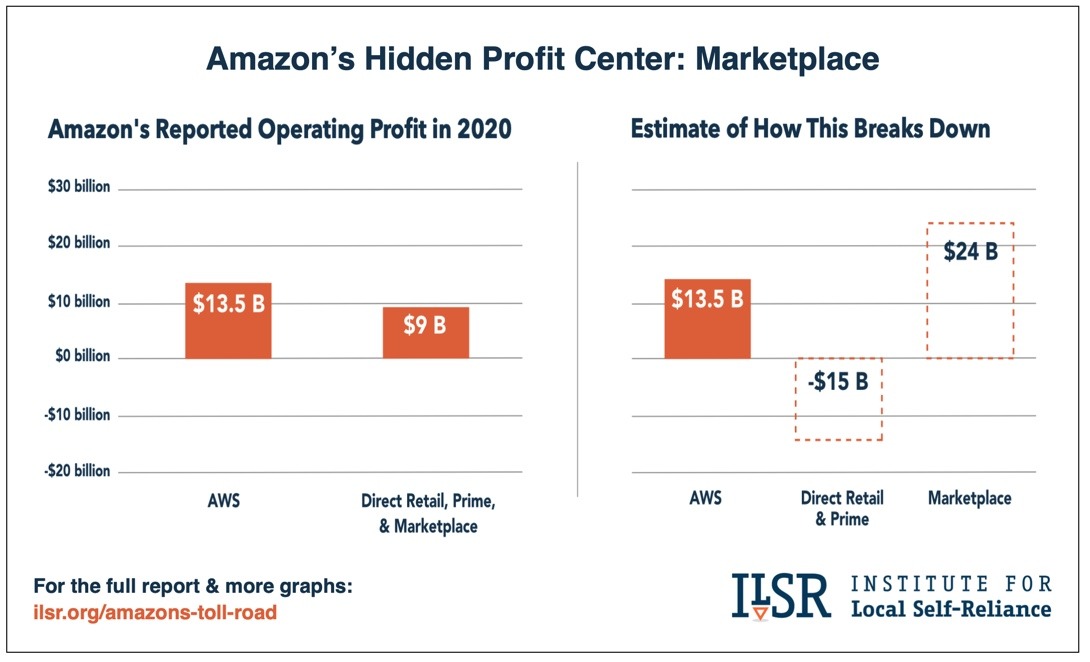
The other claim made by the report is that Amazon is using creative accounting to mask the enormous revenues generated by seller fees, grouping the huge profits of the Marketplace division with enormous losses incurred in building out their shipping infrastructure. Sure, they’re related — but it’s hardly forthcoming to present an aggregate of two wildly different numbers and claim it represents the business accurately. This is not a new allegation, but Mitchell puts specific numbers on it for 2020, making it more than a general idea.

A diagram showing how one aggregate number might misrepresent the actual profits and losses happening within Amazon.

Image Credits: ILSR

“We conclude that seller fees likely generate more profit than AWS. This contradicts conventional wisdom about the company; news stories commonly describe AWS as the source of most of Amazon’s earnings,” writes Mitchell in the summary. “Drawing on analysts’ estimates of the margins Amazon likely earns on seller advertising and other seller fees, we find that Marketplace may have generated operating profits of $24 billion in 2020 — significantly more than the $13.5 billion in profit that Amazon reported for AWS. AWS has long been seen as Amazon’s cash cow. But this report finds that the tech giant has a second cash cow, which it keeps quietly out of view.”

Amazon told me that it “cannot speculate” on 2021 revenue numbers during the year, but did not respond to a follow-up question asking whether the previous years’ numbers in the ILSR report were accurate.

Some of these practices are under scrutiny by various government powers, including an FTC led by perhaps now the world’s most famous questioner of Amazon’s business practices, Lina Khan. The ILSR report is merely informative and Amazon can wave it away, but if an FTC task force is looking into similar questions and drawing similar conclusions, the company may have reason to start sweating.


via Tingle Tech

Contact Form

Name

Email *

Message *

Powered by Blogger.