Latest Post

It’s that time of year again. Analysts and journalists from across the globe have convened in Hawaii to witness Qualcomm announce its big chip news for the year. Just a few days of sun, surf, Snapdragons and summits.

As promised, the latest version of the So Cal chip giant’s flagship SoC arrives with a rebrand – one that’s going to take some getting used to. Snapdragon 8 Gen 1 doesn’t exactly roll off the tongue like, say 888, but no one said chip nomenclatures were going to be easy. What’s more, the new silicon is arriving soon, with the first devices expected before the year’s up – giving handset makers more or less exactly four weeks to get them out the door.

Image Credits: Qualcomm

The new chip is focused on six key competencies: 5G connectivity, camera sensors, AI, gaming, audio and security – pretty much what you’d hope from a mobile chipmaker in 2021. On the connectivity front, the SoC sports a 5G modem-RF capable of hitting up 10 Gigabit download speeds, coupled with the FastConnect 6900 Mobile Connectivity System, which is claims can best WiFi 6 speeds.

The new imaging system sports an 18-bit ISP, with improved dynamic range, color and speeds. It supports 8K HDR video, coupled with a new Bokeh Engine that brings Portrait Mode-style shots to video, while an Always-On ISP delivers low power consumption to tasks like face unlock. The new Adreno GPU, meanwhile, promises improved graphics performance with lower power consumption, while support for lossless audio arrives on the sound side. As for security, the new platform sports a new Trust Management Engine, as well as support for Android Ready SE for digital car keys.

Image Credits: Qualcomm

AI may be the biggest piece of the puzzle here. A new 7th Gen engine brings improved tensor acceleration. Per Qualcomm,

The latest AI-based natural language processing from Hugging Face can intelligently serve as your personal assistant by prioritizing and analyzing your notifications. Working with Sonde Health, we are using on-device AI to accelerate their models that can analyze a user’s vocal patterns to determine if a user is at risk for health conditions such as asthma, depression, and COVID-19. Also, a new always-on AI system is powered by the 3rd Gen Qualcomm® Sensing Hub with more data streams being processed using lowest power AI.

Imaging and AI, in particularly, are key for Qualcomm this year because, let’s face it, the company’s got a lot more competition than it did only a few years back. Note the brands that have currently signed up to release devices sporting the SoC: Black Shark, Honor, iQOO, Motorola, Nubia, OnePlus, OPPO, Realme, Redmi, SHARP, Sony Corporation, vivo, Xiaomi and ZTE. It’s not a bad list, as far as these things go. I should add that I cribbed it directly from Qualcomm’s press material, so it’s alphabetical (likely for political reasons), which is how you get names like Black Shark ahead of, say, Sony. But you’ve got a number a number of big Chinese manufacturers on there, too – vivo, OPPO and Xiaomi dominate the world’s largest smartphone market. But the list is as notable for its absences than the names it includes. Huawei, is, of course, not present (unlike spinoff, Honor), as the company looks to in-house chips amid concerns with the U.S. government.

Image Credits: Qualcomm

Beyond that, big names like Google, Apple and Samsung are notably missing. Qualcomm is no doubt feeling a pinch as more companies push to develop their own in-house silicon, many of which have sported some impressive numbers in testing. That’s not to say that Qualcomm’s dominance is over among premium handsets, but chips are an increasingly important battlefield for smartphone differentiation among hardware makers with the resources to go in-house.


via Tingle Tech
Longer-term energy storage is a drag, and a lot of battery tech has been focusing on “how quickly can we charge these batteries so I can drive my EV for another couple of hundred miles.” That’s a fundamentally different problem than trying to capture the power of the sun for 12 hours, before releasing the power for the next 12 hours while the moon is doing its lazy stroll against the nighttime sky.

Energy Dome today announced the close of its $11M Series A fundraise, with the goal of deploying the first commercially viable CO2 battery in a demonstration project in its native Sardinia, Italy.

The company told us that a CO2 battery’s optimal charge/discharge cycle ranges from 4 to 24 hours, positioning it perfectly for daily and intra-day cycling. It points out that this is a fast-growing market segment, not well-served by existing battery technologies. Specifically, the hope is to charge the CO2 battery during the daytime when there is a surplus of solar-generated power, before discharging during the peak evening and nighttime hours, when demand for electricity outpaces what solar can deliver. Because, well, I’d hate to feel the need to spell this out for ya – but there’s no sun at night.

Built using commodity components, the company claims that its CO battery achieves a 75-80% round-trip efficiency. Perhaps more interestingly, though, is that the operational life for the batteries is projected to be in the neighborhood of 25 years. If you’ve been keeping an eye on other power-storage solutions, you’ll have made a mental note that the operational life of most other solutions starts to degrade significantly by the time it hits the one-decade mark. The company projects that considering the whole-lifecycle cost of its product, the cost of storing energy will be about half of the cost of storing with similar-sized lithium-ion batteries.

The tech is pretty neat – the company is using CO2 in a closed-loop cycle where it changes from gas to liquid and back to gas. The company itself is named after the “dome” component of the solution – an inflatable atmospheric gas holder filled with CO2 in its gaseous form.

When charging, the system draws electrical power from the electric grid, which drives a compressor that draws CO2 from the dome and compresses it, generating heat. The heat is stored in a thermal energy storage device. The CO2 is then liquified under pressure and stored in liquid CO2 vessels, at ambient temperature, to complete the charging cycle. When discharging, the cycle is reversed by evaporating the liquid CO2, recovering the heat from the thermal energy storage system, and expanding the hot CO2 into a turbine, which drives a generator. Electricity is returned to the grid and the CO2 re-inflates the dome without emissions to the atmosphere, ready for the next charging cycle. The system has up to 200 MWh in storage capacity.

The round was led by deep-tech VC firm 360 Capital, while a number of other investors round out the investment round, including Barclays’ Sustainable Impact Capital program, a division of the banking giant Barclays which takes an impact investment approach, Geneva-based multi-family office Novum Capital Partners, and Third Derivative, a global climate technology start-up accelerator founded by RMI and New Energy Nexus.


via Tingle Tech

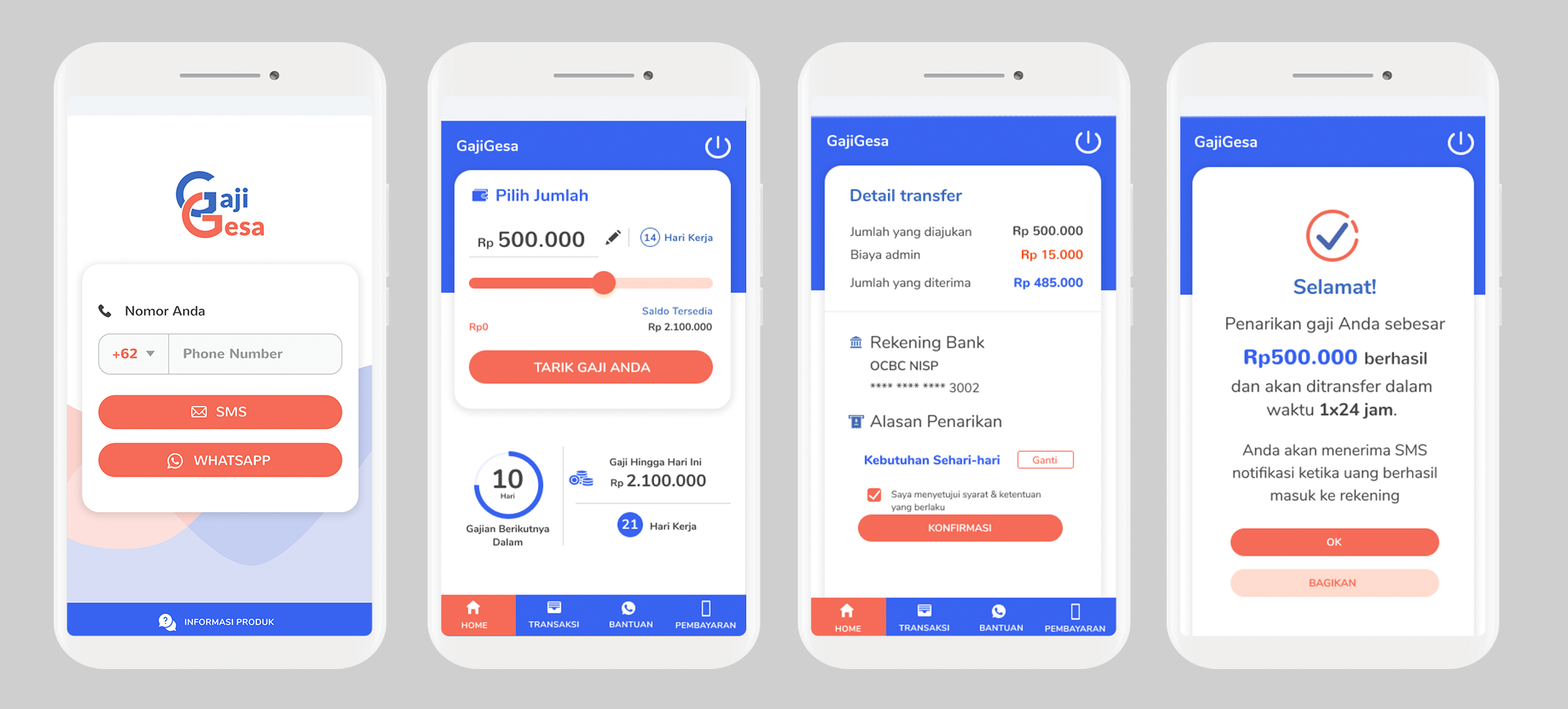
GajiGesa's earned wage access feature user flow

GajiGesa’s earned wage access feature user flow

GajiGesa, a fintech company focused on services for Indonesian workers, announced today that it has raised $6.6 million USD in pre-Series A funding. The round was led by MassMutual Ventures, with participation from January Capital, European earned wage access company Wagestream (EWA is GajiGesa’s flagship feature), Bunda Group, Smile Group, Oliver Jung, Northstar Group partners including Patrick Walujo, Nipun Mehra (the CEO of Ula) and Noah Pepper (Stripe’s head of APAC). Returning investors included defy.vc, Quest Ventures, GK Plug and Play and Next Billion Ventures.

For a more in-depth look at GajiGesa, take a look at TechCrunch’s profile of the company from February, when it raised its $2.5 million seed round.

Agrawal and Malinowska said in a press release that GajiGesa’s team has doubled in size over the past six months to over 50, and the startup plans to use its latest funding on product development, expansion across Indonesia and entering new markets in Southeast Asia.

The startup is aimed at unbanked workers and focuses on earned wage access, which lets people withdraw their wages immediately instead of waiting for monthly paychecks, because the founders—husband-and-wife team Vidit Agrawal and Martyna Malinowska—said that gives workers much more liquidity and protects them from predatory lenders.

GajiGesa now works with more than 120 companies in a wide range of sectors, including factories, plantations, manufacturing, retail, restaurants, hospitals and tech companies. Based on a survey of its clients, GajiGesa claims that over 80% of their employees have stopped using informal lenders because of its EWA feature and 40% are using other financial services through the platform like bill payments and data recharge.

The company offers an employer app called GajiTim, which it claims is Southeast Asia’s “first and largest integrated employee management solution.” By that, it means that employers can manage a wide array of workforce administrative tasks, including part-time and full-time employees and gig workers. The company says GajiTim currently has more than 200,000 users.

In a statement about the investment, MassMutual Ventures managing director Anvesh Ramineni said, “[GajiGesa’s] integrated platform combines customer-centric product design and world class technology infrastructure to ensure they are uniquely positioned to empower an chronically underserved market and help expand financial resilience for millions across Southeast Asia.


via Tingle Tech

TL;DR: The Complete 2021 Superstar Photographer Bundle is on sale for £22.44 as of Nov. 30, saving you 98% on list price.


Photography is a lot more than just pointing and clicking. It’s an art that requires knowledge of lighting, posing, exposure, composition, editing, and more.

If your DSLR has been gathering dust in a corner, now’s a great time to brush it off and use it again. This Complete 2021 Superstar Photographer Bundle includes 11 different courses covering the ins and outs of photography, and for a limited time, it’s on sale for only £22.44.

With the help of instructors Phil Ebiner, a skilled creator, videographer, and photographer known for landscapes; Jellis Vaes, an artist and entrepreneur; and Mark Timberlake, a jack-of-all-trades with a personal passion for photography, you’ll demystify how to take great photos.

To kick things off, you'll take a beginners' course design to help you understand photography fundamentals. Then you’ll tackle capturing portraits, landscapes, food, studio, night, and even weddings. Of course, along the way, you’ll also learn to work with lighting, points of contrast, leading lines, the rule of thirds, and more.

To finish off your photography training, you’ll also learn how to process and edit photos in Photoshop and Lightroom, two of the most popular photo editing tools professionals use today. After all, even the best photographers in the world still do some touchups and edits after the photo is taken.

For a limited time, you can virtually enroll in all 11 courses for only £22.44.

Man holding camera
Credit: Skill Success


via Tingle Tech

TL;DR: The 2021 Complete Learn to Code by Making Games in Unity Bundle is on sale for £29.92 as of Nov. 30, saving you 97% on list price.


Want to start learning how to code your own video games? Consider the Complete Learn to Code By Making Games in Unity Bundle. This collection of classes includes eight courses and over 900 lessons on coding, machine learning, Construct 3, and more.

You'll start by learning how to use Construct 3 to create your own computer games by building simple pixel art animations. Then you'll move on to Unity, where you'll learn how to build a Battle Royale game essentially from scratch. Even if you've never coded before, this course is a great introductory lesson and will walk you through the process.

The other courses break down how to make other types of games, including spaceship games and even cutting-edge 3D pathfinding games. As you move through the courses, you'll study the basics and build a solid foundation. Eventually, you'll walk away with the skills to think creatively and work to solve technical glitches and issues.

Each of these eight courses are taught by Mammoth Interactive and boasts an average of 4.6 out of 5 stars by reviewers who've actually completed them. Mammoth Interactive produces games for XBOX 360, iPhone, iPad, and more.

Normally, these courses would retail for a total of £1,200. But for a limited time, you can score the bundle for just £29.92.

Boy sitting on controller cartoon
Credit: Mammoth Interactive


via Tingle Tech

Three former Google engineers are suing their former employer, alleging they were unjustly fired after calling out "evil."

Filed to the Santa Clara County Superior Court on Monday, the lawsuit claims software engineers Rebecca Rivers, Sophie Waldman, and Paul Duke had merely followed a contractual obligation to hold Google to account regarding its "Don't be evil" mantra — an obligation they say was imposed by the company itself.

"Google terminated each Plaintiffs’ employment with it for adhering to the directive 'Don’t be evil' and calling out activity by Google that they each believed betrayed that directive," read the lawsuit. "Each Plaintiff fulfilled their contractual duty to Google by advising it... ways in which Google was 'Doing evil.'"

In particular, the call out concerned Google's alleged intent to do business with border and immigration officials under Trump's administration in 2019. Ethical concerns regarding organisations such as U.S. Customs and Border Protection (CBP) and Immigration and Customs Enforcement (ICE) were a significant issue at the time, with the U.S. government ultimately holding over 69,000 children in custody over the course of the year.

According to the lawsuit, Rivers, Waldman, and Duke each signed an employment contract which included Google's Code of Conduct. This Code read, in part:

"['Don't be evil' is about] following the law, acting honorably and treating each other with respect. The Google Code of Conduct is one of the ways we put 'Don't be evil' into practice. It's built around the recognition that everything we do in connection with our work at Google will be, and should be, measured against the highest possible standards of ethical business conduct… And if you have a question or ever think that one of your fellow Googlers or the company as a whole may be falling short of our commitment, don't be silent."

To many, certain actions of agencies such as CBP and ICE very clearly constitute "evil." As such, Waldman and Duke launched an internal petition in Aug. 2019 requesting that Google affirm it would not work with these organisations, in line with its commitment not to "be evil." Rivers subsequently discovered that Google had offered a free trial of a cloud platform to CBP, information which was added to the petition. 

The plaintiffs allege that all information included in the petition was already freely accessible by all Google employees, and that they repeatedly directed their co-workers not to share it outside the company. The suit also contends that an internal investigation failed to find them at fault and they were not reprimanded in any way.

Nevertheless, all three engineers were fired in Nov. 2019, with an internal memo from Google's Securities and Investigations Team stating that they were let go for "clear and repeated violations of our data security policies." This allegedly included "systematic searches" for information "outside the scope of their job."

Mashable has reached out to Google for comment.

Days before the firings, around 200 Google employees rallied outside its San Francisco office in support of Rivers and another suspended staffer, accusing the tech giant of retaliation. Rivers had been placed on administrative leave after Google interviewed her regarding her access of documents concerning the company's relationship with CBP.

Google's infamous "Don't be evil" motto was quietly removed from the company's Code of Conduct in mid-2018. In some ways this makes sense. We've learnt anything from the past five years, it's that what constitutes "evil" can be extremely subjective. This lawsuit also demonstrates the aspirational phrase has caused the tech giant some headaches.

But on the other hand: yikes.


via Tingle Tech

Meet Upway, a French startup that is building a marketplace for second-hand electric bikes. The startup just raised a $5.7 million (€5 million) seed round from Sequoia Capital and Global Founders Capital.

If you’re familiar with the world of online marketplaces for cars, Upway will sound familiar to you as well. The company buys electric bikes from both customers and companies. They check them and repair them in case something is broken. After that, Upway lists and sells the electric bikes on its website.

Right now, the startup has a warehouse in Gennevilliers near Paris. A team of five repairpersons check each bike that arrives with a list of 20 different tests. Upway can then ship the bike to customers in a cardboard package — the handlebar and pedals are detached from the frame.

On average, bikes are 20% to 50% cheaper than their original cost. You can find products from many familiar brands in the electric bike industry, such as Moustache, VanMoof, Cowboy and Canyon. All electric bikes come with a one year warranty.

Why electric bikes and not normal bikes? Co-founder and CEO Toussaint Wattinne told me that electric bikes are the fastest growing segment of the bike industry. Last year, 500,000 electric bikes were sold in France — that’s a 30% increase compared to the previous year. And yet, due to supply chain issue, it’s not always easy to find and buy a new electric bike right now.

Moreover, there’s more friction when you buy a second-hand electric bike as you don’t know if the motor still works fine and you’re not sure if you’ll have to replace the battery when you get it. And, of course, electric bikes are expensive goods so you want a no-fuss experience.

Upway buys bikes directly, which means that it technically owns the stock of electric bikes. It’s going to be a capital-intensive startup. But many companies have thrived in the used car marketplace space. Upway could follow the same path and grow alongside the electric bike industry.

Image Credits: Upway


via Tingle Tech

Contact Form

Name

Email *

Message *

Powered by Blogger.